SIGA O COLETIVIZANDO!

Mostrando postagens com marcador Putin. Mostrar todas as postagens

quarta-feira, 2 de março de 2022

Conflito na Ucrânia:A paz deve ser o objetivo imediato alcançado - CEBRAPAZ


Conflito na Ucrânia: A paz deve ser o objetivo imediato alcançado

“O atual conflito tem suas raízes na agressiva expansão dos EUA e da OTAN, após o fim da União Soviética, em direção às fronteiras da Federação Russa, ali instalando bases militares e armas nucleares, ignorando os repetidos e insistentes protestos da Rússia, hoje totalmente cercada por forças hostis”, diz, em nota, o Cebrapaz.

O Centro Brasileiro de Solidariedade aos Povos e Luta pela Paz (Cebrapaz) defendeu, em nota, um cessar-fogo que construa o ambiente de diálogo na Ucrânia; uma solução política para o conflito que contemple as preocupações de segurança da Rússia e desmantele os grupos neonazistas; e o fim da política de provocações e guerra da Otan/EUA.

Conheça a íntegra da nota do Cebrepaz:

A humanidade acompanha com extrema preocupação o desenrolar dos acontecimentos na Europa Oriental, com a eclosão do conflito militar envolvendo a Rússia e a Ucrânia.

O Cebrapaz defende negociações que conduzam ao cessar-fogo e que permitam criar um ambiente de diálogo e a construção de uma saída política para esse conflito.

A paz deve ser o objetivo imediato e urgente a ser alcançado!

A defesa consequente da paz exige que as causas e os principais responsáveis pela guerra sejam identificados.

O atual conflito tem suas raízes na agressiva expansão dos EUA e da OTAN, após o fim da União Soviética, em direção às fronteiras da Federação Russa, ali instalando bases militares e armas nucleares, ignorando os repetidos e insistentes protestos da Rússia, hoje totalmente cercada por forças hostis.

Após as ondas de expansão militar, os EUA e a OTAN patrocinaram, em 2014, um golpe de estado, que destituiu o presidente eleito da Ucrânia – por resistir a uma integração à OTAN – levando grupos neonazistas ao poder.

A rebelião das populações do leste da Ucrânia contra esse golpe foi reprimida “a ferro e fogo” pelo governo de Kiev, com a conivência e o apoio dos EUA e da OTAN.

Os acordos de Minsk, de 2014, que buscaram pacificar o país, foram ignorados por Kiev – sob os olhos complacentes dos EUA e da União Europeia. Seguiram-se oito anos de ataques das Forças Armadas ucranianas às populações de Lugansk e Donetsk, causando a morte de milhares de cidadãos ucranianos, em especial de origem russa, na região de Donbass.

Por essas razões, não pode restar dúvidas de que os EUA e a OTAN são os principais responsáveis pelo atual conflito na Europa Oriental.

Denunciamos também a manipulação do vasto aparato midiático hegemônico que torna invisível a expansão guerreira da OTAN e dos EUA e o apoio prestado por eles aos grupos neonazistas ucranianos, procurando colocar sobre a Federação Russa toda a responsabilidade da atual crise.

Condenamos, além disso, as sanções econômicas contra a Federação Russa, que em nada contribuem para a paz e, ao contrário, tornam ainda mais tensa a situação.

Assim, o Cebrapaz defende:

  • Um cessar-fogo que construa o ambiente de diálogo.
  • Uma solução política para o conflito que contemple as preocupações de segurança da Rússia e desmantele os grupos neonazistas.
  • O fim da política de provocações e guerra da Otan/EUA.

Executiva Nacional Ampliada do Cebrapaz

28/02/2022

Fonte: Portal do Cebrapaz

sexta-feira, 19 de março de 2021

Putin dá resposta épica a Biden - Sputnik

Sputnik no Youtube

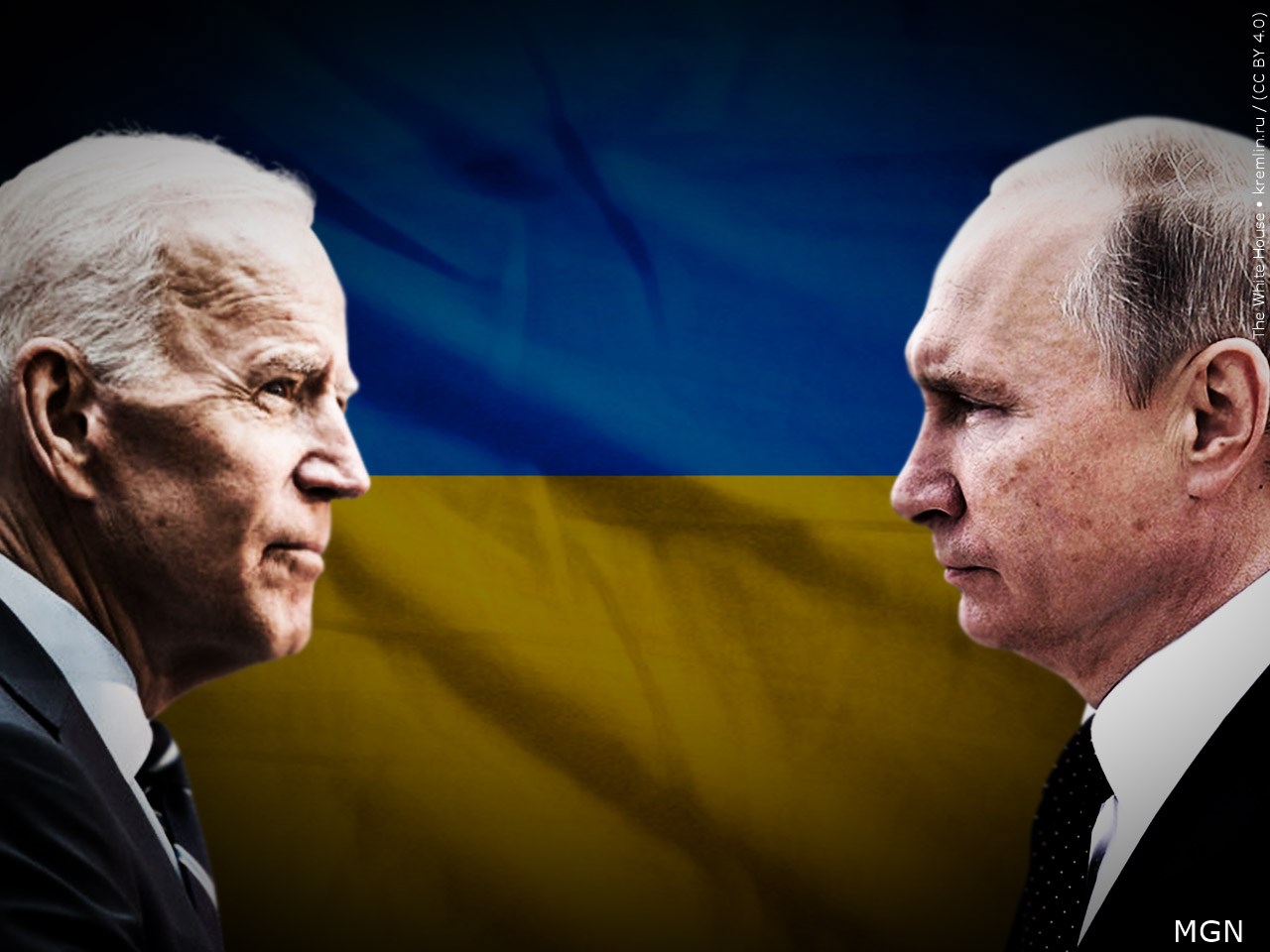
Em entrevista ao jornalista da ABC, George Stephanopoulos, o Presidente estadunidense Joe Biden assentiu à pergunta capciosa, de se considerava o homólogo Russo um assassino. Biden assentiu, mas viu-se que fora pego de surpresa e seu hu-hum afirmativo mostra a tibieza. Contudo, no contexto, são exatamente acusações e ataques que se fazem contra a Rússia e seu mandatário.

A resposta não tardou. Putin fez um vídeo direto, olhos nos olhos - pois foi acusado de ser frio no olhar. Antes de tudo, deseja saúde ao idoso Joe Biden. Fica no ar a alfinetada sobre se suas declarações eram intencionais ou um lapso. E em seguida devolve com brilho e gênio ao ataque recebido. Um show.


domingo, 7 de fevereiro de 2021

Putin' Speech - Davos - 2021- Russia Briefing and WEF - 28/01/2021


Russian President Putin’s Speech At The World Economic Forum: Complete English Translation
January 28, 2021Posted by Russia Briefing


“Love is impossible if it is declared only by one side. It must be mutual.”
Highly Critical of US Social Media and Big Tech
“Russia & Europe” belong together
Warns of World Approaching Unsettling Political Future

The Russian President Vladimir Putin made a Keynote Address at the World Economic Forum yesterday, criticizing the growing influence of U.S. social media companies saying that their impact on society now puts them in competition with elected governments.

Putin’s virtual address, was his first to the WEF since 2009. The full transcription is as follows:

Introduction By World Economic Forum Founder Klaus Schwab:

Mr. President, welcome to the Davos Agenda Week.
Russia is an important global power, and there’s a long-standing tradition of Russia’s participation in the World Economic Forum. At this moment in history, where the world has a unique and short window of opportunity to move from an age of confrontation to an age of cooperation, the ability to hear your voice, the voice of the President of the Russian Federation, is essential. Even and especially in times characterized by differences, disputes and protests, constructive and honest dialogue to address our common challenges is better than isolation and polarization.

Yesterday, your phone exchange with President Biden and the agreement to extend the New START nuclear arms treaty in principle, I think, was a very promising sign in this direction.

COVID-19, Mr President, has shown our global vulnerability and interconnectivity, and, like any other country, Russia will certainly also be affected, and your economic development and prospects for international cooperation, of course, are of interest to all of us.

Mr. President, we are keen to hear from your perspective and from that of Russia, how you see the situation developing in the third decade of the 21st century and what should be done to ensure that people everywhere find peace and prosperity.

Mr. President, the world is waiting to hear from you.

President of Russia Vladimir Putin:

“Mr. Schwab, dear Klaus, Colleagues,

I have been to Davos many times, attending the events organized by Mr. Schwab, even back in the 1990s. Klaus just recalled that we met in 1992. Indeed, during my time in St Petersburg, I visited this important forum many times. I would like to thank you for this opportunity today to convey my point of view to the expert community that gathers at this world-renowned platform thanks to the efforts of Mr. Schwab.

First of all, ladies and gentlemen, I would like to greet all the World Economic Forum participants.

It is gratifying that this year, despite the pandemic, despite all the restrictions, the forum is still continuing its work. Although it is limited to online participation, the forum is taking place anyway, providing an opportunity for participants to exchange their assessments and forecasts during an open and free discussion, partially compensating for the increasing lack of in-person meetings between leaders of states, representatives of international business and the public in recent months. All this is very important now when we have so many difficult questions to answer.

The current forum is the first one in the beginning of the third decade of the 21st century and, naturally, the majority of its topics are devoted to the profound changes that are taking place in the world.

Indeed, it is difficult to overlook the fundamental changes in the global economy, politics, social life, and technology. The coronavirus pandemic, which Klaus just mentioned, which became a serious challenge for humankind, only spurred and accelerated the structural changes, the conditions for which had been created long ago. The pandemic has exacerbated the problems and imbalances that built up in the world before. There is every reason to believe that differences are likely to grow stronger. These trends may appear practically in all areas.

Needless to say, there are no direct parallels in history. However, some experts – and I respect their opinion – compare the current situation to the 1930s. One can agree or disagree, but certain analogies are still suggested by many parameters, including the comprehensive, systemic nature of the challenges and potential threats.

We are seeing a crisis of the previous models and instruments of economic development. Social stratification is growing stronger both globally and in individual countries. We have spoken about this before as well. But this, in turn, is causing today a sharp polarization of public views, provoking the growth of populism, right- and left-wing radicalism and other extremes, and the exacerbation of domestic political processes including in the leading countries.

All this is inevitably affecting the nature of international relations and is not making them more stable or predictable. International institutions are becoming weaker, regional conflicts are emerging one after another, and the system of global security is deteriorating.

Klaus has mentioned the conversation I had yesterday with the US President on extending the New START. This is, without a doubt, a step in the right direction. Nevertheless, the differences are leading to a downward spiral. As you are aware, the inability and unwillingness to find substantive solutions to problems like this in the 20th century led to the WWII catastrophe.

Of course, such a heated global conflict is impossible in principle, I hope. This is what I am pinning my hopes on, because this would be the end of humanity. However, as I have said, the situation could take an unexpected and uncontrollable turn – unless we do something to prevent this. There is a chance that we will face a formidable break-down in global development, which will be fraught with a war of all against all and attempts to deal with contradictions through the appointment of internal and external enemies and the destruction of not only traditional values such as the family, which we hold dear in Russia, but fundamental freedoms such as the right of choice and privacy.

I would like to point out the negative demographic consequences of the ongoing social crisis and the crisis of values, which could result in humanity losing entire civilizational and cultural continents.

We have a shared responsibility to prevent this scenario, which looks like a grim dystopia, and to ensure instead that our development takes a different trajectory – positive, harmonious, and creative.

In this context, I would like to speak in more detail about the main challenges which, I believe, the international community is facing.

The first one is socioeconomic.

Indeed, judging by the statistics, even despite the deep crises in 2008 and 2020, the last 40 years can be referred to as successful or even super successful for the global economy. Starting from 1980, global per capita GDP has doubled in terms of real purchasing power parity. This is definitely a positive indicator.

Globalization and domestic growth have led to strong growth in developing countries and lifted over a billion people out of poverty. So, if we take an income level of $5.50 per person per day (in terms of PPP) then, according to the World Bank, in China, for example, the number of people with lower incomes went from 1.1 billion in 1990 down to less than 300 million in recent years. This is definitely China’s success. In Russia, this number went from 64 million people in 1999 to about 5 million now. We believe this is also progress in our country, and in the most important area, by the way.

Still, the main question, the answer to which can, in many respects, provide a clue to today’s problems, is what was the nature of this global growth and who benefitted from it most.

Of course, as I mentioned earlier, developing countries benefitted a lot from the growing demand for their traditional and even new products. However, this integration into the global economy has resulted in more than just new jobs or greater export earnings. It also had its social costs, including a significant gap in individual incomes.

What about the developed economies where average incomes are much higher? It may sound ironic, but stratification in the developed countries is even deeper. According to the World Bank, 3.6 million people subsisted on incomes of under $5.50 per day in the United States in 2000, but in 2016 this number grew to 5.6 million people.

Meanwhile, globalization led to a significant increase in the revenue of large multinational, primarily US and European, companies.

By the way, in terms of individual income, the developed economies in Europe show the same trend as the United States.

But then again, in terms of corporate profits, who got hold of the revenue? The answer is clear: one percent of the population.

And what has happened in the lives of other people? In the past 30 years, in a number of developed countries, the real incomes of over half of the citizens have been stagnating, not growing. Meanwhile, the cost of education and healthcare services has gone up. Do you know by how much? Three times.

In other words, millions of people even in wealthy countries have stopped hoping for an increase of their incomes. In the meantime, they are faced with the problem of how to keep themselves and their parents healthy and how to provide their children with a decent education.

There is no call for a huge mass of people and their number keeps growing. Thus, according to the International Labour Organization (ILO), in 2019, 21 percent or 267 million young people in the world did not study or work anywhere. Even among those who had jobs (these are interesting figures) 30 percent had an income below $3.2 per day in terms of purchasing power parity.

These imbalances in global socioeconomic development are a direct result of the policy pursued in the 1980s, which was often vulgar or dogmatic. This policy rested on the so-called Washington Consensus with its unwritten rules, when the priority was given to the economic growth based on a private debt in conditions of deregulation and low taxes on the wealthy and the corporations.

As I have already mentioned, the coronavirus pandemic has only exacerbated these problems. In the last year, the global economy sustained its biggest decline since WWII. By July, the labour market had lost almost 500 million jobs. Yes, half of them were restored by the end of the year but still almost 250 million jobs were lost. This is a big and very alarming figure. In the first nine months of the past year alone, the losses of earnings amounted to $3.5 trillion. This figure is going up and, hence, social tension is on the rise.

At the same time, post-crisis recovery is not simple at all. If some 20 or 30 years ago, we would have solved the problem through stimulating macroeconomic policies (incidentally, this is still being done), today such mechanisms have reached their limits and are no longer effective. This resource has outlived its usefulness. This is not an unsubstantiated personal conclusion.

According to the IMF, the aggregate sovereign and private debt level has approached 200 percent of global GDP, and has even exceeded 300 percent of national GDP in some countries. At the same time, interest rates in developed market economies are kept at almost zero and are at a historic low in emerging market economies.

Taken together, this makes economic stimulation with traditional methods, through an increase in private loans virtually impossible. The so-called quantitative easing is only increasing the bubble of the value of financial assets and deepening the social divide. The widening gap between the real and virtual economies (incidentally, representatives of the real economy sector from many countries have told me about this on numerous occasions, and I believe that the business representatives attending this meeting will agree with me) presents a very real threat and is fraught with serious and unpredictable shocks.

Hopes that it will be possible to reboot the old growth model are connected with rapid technological development. Indeed, during the past 20 years we have created a foundation for the so-called Fourth Industrial Revolution based on the wide use of AI and automation and robotics. The coronavirus pandemic has greatly accelerated such projects and their implementation.

However, this process is leading to new structural changes, I am thinking in particular of the labor market. This means that very many people could lose their jobs unless the state takes effective measures to prevent this. Most of these people are from the so-called middle class, which is the basis of any modern society.

In this context, I would like to mention the second fundamental challenge of the forthcoming decade – the socio-political one. The rise of economic problems and inequality is splitting society, triggering social, racial and ethnic intolerance. Indicatively, these tensions are bursting out even in the countries with seemingly civil and democratic institutions that are designed to alleviate and stop such phenomena and excesses.

The systemic socioeconomic problems are evoking such social discontent that they require special attention and real solutions. The dangerous illusion that they may be ignored or pushed into the corner is fraught with serious consequences.

In this case, society will still be divided politically and socially. This is bound to happen because people are dissatisfied not by some abstract issues but by real problems that concern everyone regardless of the political views that people have or think they have. Meanwhile, real problems evoke discontent.

I would like to emphasize one more important point. Modern technological giants, especially digital companies, have started playing an increasing role in the life of society. Much is being said about this now, especially regarding the events that took place during the election campaign in the US. They are not just some economic giants. In some areas, they are de facto competing with states. Their audiences consist of billions of users that pass a considerable part of their lives in these eco systems.

In the opinion of these companies, their monopoly is optimal for organizing technological and business processes. Maybe so but society is wondering whether such monopolism meets public interests. Where is the border between successful global business, in-demand services and big data consolidation and the attempts to manage society at one’s own discretion and in a tough manner, replace legal democratic institutions and essentially usurp or restrict the natural right of people to decide for themselves how to live, what to choose and what position to express freely? We have just seen all of these phenomena in the US and everyone understands what I am talking about now. I am confident that the overwhelming majority of people share this position, including the participants in the current event.

And finally, the third challenge, or rather, a clear threat that we may well run into in the coming decade is the further exacerbation of many international problems. After all, unresolved and mounting internal socioeconomic problems may push people to look for someone to blame for all their troubles and to redirect their irritation and discontent. We can already see this. We feel that the degree of foreign policy propaganda rhetoric is growing.

We can expect the nature of practical actions to also become more aggressive, including pressure on the countries that do not agree with a role of obedient controlled satellites, use of trade barriers, illegitimate sanctions and restrictions in the financial, technological and cyber spheres.

Such a game with no rules critically increases the risk of unilateral use of military force. The use of force under a far-fetched pretext is what this danger is all about. This multiplies the likelihood of new hot spots flaring up on our planet. This concerns us.

Colleagues, despite this tangle of differences and challenges, we certainly should keep a positive outlook on the future and remain committed to a constructive agenda. It would be naive to come up with universal miraculous recipes for resolving the above problems. But we certainly need to try to work out common approaches, bring our positions as close as possible and identify sources that generate global tensions.

Once again, I want to emphasize my thesis that accumulated socioeconomic problems are the fundamental reason for unstable global growth.

So, the key question today is how to build a program of actions in order to not only quickly restore the global and national economies affected by the pandemic, but to ensure that this recovery is sustainable in the long run, relies on a high-quality structure and helps overcome the burden of social imbalances. Clearly, with the above restrictions and macroeconomic policy in mind, economic growth will largely rely on fiscal incentives with state budgets and central banks playing the key role.

Actually, we can see these kinds of trends in the developed countries and also in some developing economies as well. An increasing role of the state in the socioeconomic sphere at the national level obviously implies greater responsibility and close interstate interaction when it comes to issues on the global agenda.

Calls for inclusive growth and for creating decent standards of living for everyone are regularly made at various international forums. This is how it should be, and this is an absolutely correct view of our joint efforts.

It is clear that the world cannot continue creating an economy that will only benefit a million people, or even the golden billion. This is a destructive precept. This model is unbalanced by default. The recent developments, including migration crises, have reaffirmed this once again.

We must now proceed from stating facts to action, investing our efforts and resources into reducing social inequality in individual countries and into gradually balancing the economic development standards of different countries and regions in the world. This would put an end to migration crises.

The essence and focus of this policy aimed at ensuring sustainable and harmonious development are clear. They imply the creation of new opportunities for everyone, conditions under which everyone will be able to develop and realize their potential regardless of where they were born and are living

I would like to point out four key priorities, as I see them. This might be old news, but since Klaus has allowed me to present Russia’s position, my position, I will certainly do so.

First, everyone must have comfortable living conditions, including housing and affordable transport, energy and public utility infrastructure. Plus environmental welfare, something that must not be overlooked.

Second, everyone must be sure that they will have a job that can ensure sustainable growth of income and, hence, decent standards of living. Everyone must have access to an effective system of lifelong education, which is absolutely indispensable now and which will allow people to develop, make a career and receive a decent pension and social benefits upon retirement.

Third, people must be confident that they will receive high-quality and effective medical care whenever necessary, and that the national healthcare system will guarantee access to modern medical services.

Fourth, regardless of the family income, children must be able to receive a decent education and realize their potential. Every child has potential.

This is the only way to guarantee the cost-effective development of the modern economy, in which people are perceived as the end, rather than the means. Only those countries capable of attaining progress in at least these four areas will facilitate their own sustainable and all-inclusive development. These areas are not exhaustive, and I have just mentioned the main aspects.

A strategy, also being implemented by my country, hinges on precisely these approaches. Our priorities revolve around people, their families, and they aim to ensure demographic development, to protect the people, to improve their well-being and to protect their health. We are now working to create favorable conditions for worthy and cost-effective work and successful entrepreneurship and to ensure digital transformation as the foundation of a high-tech future for the entire country, rather than that of a narrow group of companies.

We intend to focus the efforts of the state, the business community and civil society on these tasks and to implement a budgetary policy with the relevant incentives in the years ahead.

We are open to the broadest international cooperation, while achieving our national goals, and we are confident that cooperation on matters of the global socioeconomic agenda would have a positive influence on the overall atmosphere in global affairs, and that interdependence in addressing acute current problems would also increase mutual trust which is particularly important and particularly topical today.

Obviously, the era linked with attempts to build a centralized and unipolar world order has ended. To be honest, this era did not even begin. A mere attempt was made in this direction, but this, too, is now history. The essence of this monopoly ran counter to our civilization’s cultural and historical diversity.

The reality is such that really different development centers with their distinctive models, political systems and public institutions have taken shape in the world. Today, it is very important to create mechanisms for harmonizing their interests to prevent the diversity and natural competition of the development poles from triggering anarchy and a series of protracted conflicts.

To achieve this we must, in part, consolidate and develop universal institutions that bear special responsibility for ensuring stability and security in the world and for formulating and defining the rules of conduct both in the global economy and trade.

I have mentioned more than once that many of these institutions are not going through the best of times. We have been bringing this up at various summits. Of course, these institutions were established in a different era. This is clear. Probably, they even find it difficult to parry modern challenges for objective reasons. However, I would like to emphasize that this is not an excuse to give up on them without offering anything in exchange, all the more so since these structures have unique experience of work and a huge but largely untapped potential. And it certainly needs to be carefully adapted to modern realities. It is too early to dump it in the dustbin of history. It is essential to work with it and to use it.

Naturally, in addition to this, it is important to use new, additional formats of cooperation. I am referring to such phenomenon as multiversity. Of course, it is also possible to interpret it differently, in one’s own way. It may be viewed as an attempt to push one’s own interests or feign the legitimacy of one’s own actions when all others can merely nod in approval. Or it may be a concerted effort of sovereign states to resolve specific problems for common benefit. In this case, this may refer to the efforts to settle regional conflicts, establish technological alliances and resolve many other issues, including the formation of cross-border transport and energy corridors and so on and so forth.

Friends,

Ladies and gentlemen,

This opens wide possibilities for collaboration. Multi-faceted approaches do work. We know from practice that they work. As you may be aware, within the framework of, for example, the Astana format, Russia, Iran, and Turkey are doing much to stabilize the situation in Syria and are now helping establish a political dialogue in that country, of course, alongside other countries. We are doing this together. And, importantly, not without success.

For example, Russia has undertaken energetic mediation efforts to stop the armed conflict in Nagorno-Karabakh, in which peoples and states that are close to us – Azerbaijan and Armenia – are involved. We strived to follow the key agreements reached by the OSCE Minsk Group, in particular between its co-chairs – Russia, the United States and France. This is also a very good example of cooperation.

As you may be aware, a trilateral Statement by Russia, Azerbaijan and Armenia was signed in November. Importantly, by and large, it is being steadily implemented. The bloodshed was stopped. This is the most important thing. We managed to stop the bloodshed, achieve a complete ceasefire and start the stabilization process.

Now the international community and, undoubtedly, the countries involved in crisis resolution are faced with the task of helping the affected areas overcome humanitarian challenges related to returning refugees, rebuilding destroyed infrastructure, protecting and restoring historical, religious and cultural landmarks.

Or, another example. I will note the role of Russia, Saudi Arabia, the United States and a number of other countries in stabilizing the global energy market. This format has become a productive example of interaction between the states with different, sometimes even diametrically opposite assessments of global processes, and with their own outlooks on the world.

At the same time there are certainly problems that concern every state without exception. One example is cooperation in studying and countering the coronavirus infection. As you know, several strains of this dangerous virus have emerged. The international community must create conditions for cooperation between scientists and other specialists to understand how and why coronavirus mutations occur, as well as the difference between the various strains.

Of course, we need to coordinate the efforts of the entire world, as the UN Secretary-General suggests and as we urged recently at the G20 summit. It is essential to join and coordinate the efforts of the world in countering the spread of the virus and making the much needed vaccines more accessible. We need to help the countries that need support, including the African nations. I am referring to expanding the scale of testing and vaccinations.

We see that mass vaccination is accessible today, primarily to people in the developed countries. Meanwhile, millions of people in the world are deprived even of the hope for this protection. In practice, such inequality could create a common threat because this is well known and has been said many times that it will drag out the epidemic and uncontrolled hotbeds will continue. The epidemic has no borders.

There are no borders for infections or pandemics. Therefore, we must learn the lessons from the current situation and suggest measures aimed at improving the monitoring of the emergence of such diseases and the development of such cases in the world.

Another important area that requires coordination, in fact, the coordination of the efforts of the entire international community, is to preserve the climate and nature of our planet. I will not say anything new in this respect.

Only together can we achieve progress in resolving such critical problems as global warming, the reduction of forestlands, the loss of biodiversity, the increase in waste, the pollution of the ocean with plastic and so on, and find an optimal balance between economic development and the preservation of the environment for the current and future generations.

My friends,

We all know that competition and rivalry between countries in world history never stopped, do not stop and will never stop. Differences and a clash of interests are also natural for such a complicated body as human civilization. However, in critical times this did not prevent it from pooling its efforts – on the contrary, it united in the most important destinies of humankind. I believe this is the period we are going through today.

It is very important to honestly assess the situation, to concentrate on real rather than artificial global problems, on removing the imbalances that are critical for the entire international community. I am sure that in this way we will be able to achieve success and befittingly parry the challenges of the third decade of the 21st century.

I would like to finish my speech at this point and thank all of you for your patience and attention.

Thank you very much.

Klaus Schwab: Thank you very much, Mr. President.

Many of the issues raised, certainly, are part of our discussions here during the Davos Week. We complement the speeches also by task forces which address some of the issues you mentioned, like not leaving the developing world behind, taking care of, let’s say, creating the skills for tomorrow, and so on. Mr. President, we prepare for the discussion afterwards, but I have one very short question. It is a question which we discussed when I visited you in St Petersburg 14 months ago. How do you see the future of European-Russian relations? Just a short answer.

Vladimir Putin: You know there are things of an absolutely fundamental nature such as our common culture. Major European political figures have talked in the recent past about the need to expand relations between Europe and Russia, saying that Russia is part of Europe. Geographically and, most importantly, culturally, we are one civilization. French leaders have spoken of the need to create a single space from Lisbon to the Urals. I believe, and I mentioned this, why the Urals? To Vladivostok.

I personally heard the outstanding European politician, former Chancellor Helmut Kohl, say that if we want European culture to survive and remain a center of world civilization in the future, keeping in mind the challenges and trends underlying the world civilization, then of course, Western Europe and Russia must be together. It is hard to disagree with that. We hold exactly the same point of view.

Clearly, today’s situation is not normal. We need to return to a positive agenda. This is in the interests of Russia and, I am confident, the European countries. Clearly, the pandemic has also played a negative role. Our trade with the European Union is down, although the EU is one of our key trade and economic partners. Our agenda includes returning to positive trends and building up trade and economic cooperation.

Europe and Russia are absolutely natural partners from the point of view of the economy, research, technology and spatial development for European culture, since Russia, being a country of European culture, is a little larger than the entire EU in terms of territory. Russia’s resources and human potential are enormous. I will not go over everything that is positive in Europe, which can also benefit the Russian Federation.

Only one thing matters: we need to approach the dialogue with each other honestly. We need to discard the phobias of the past, stop using the problems that we inherited from past centuries in internal political processes and look to the future. If we can rise above these problems of the past and get rid of these phobias, then we will certainly enjoy a positive stage in our relations.

We are ready for this, we want this, and we will strive to make this happen. But love is impossible if it is declared only by one side. It must be mutual.”

terça-feira, 12 de maio de 2020

EUA falsificam a História para minimizar papel soviético na 2ª Guerra


País perdeu 27 milhões de pessoas e libertou os judeus do campo de concentração Auschwitz

Vermelho


O governo da Rússia acusou os Estados Unidos de falsificarem a História e relativizarem o papel da União Soviética no desfecho da 2ª Guerra Mundial (1939-1945). Em comunicado publicado neste domingo (10), o ministério russo das Relações Exteriores afirmou que as autoridades estão “extremamente indignadas com as tentativas de distorcer a transcendência da contribuição decisiva de nosso país”

Segundo o documento, os Estados Unidos tentam minimizar e “distorcer” o papel da União Soviética na vitória contra a Alemanha nazista. A Casa Branca havia emitido uma nota no Facebook apenas mencionando os EUA e a Grã-Bretanha como vencedores na terrível guerra. Após isso, a Rússia exigiu uma “conversa séria” sobre o assunto com representantes do governo Donald Trump.

“Os funcionários americanos não tiveram a coragem nem a vontade de homenagear o papel inegável e a quantidade colossal de vítimas que o Exército Vermelho e o povo soviético sofreram em nome de toda a humanidade”, destacou Moscou no texto. Além dos EUA, a Rússia acusa também Europa, Ucrânia e Polônia por menosprezar o papel exercido pela União Soviética.


É inegável a épica participação dos soviéticos no conflito – sempre objeto de admiração do presidente Vladimir Putin e dos cidadãos russos. O país perdeu cerca de 27 milhões de pessoas e foi o responsável pela libertação do campo de concentração Auschwitz, além da destruição do bunker no qual Hitler cometeu suicídio, em 1945.

Com informações do site Aventura na História

terça-feira, 22 de julho de 2014

Fidel Castro: É hora de conhecer um pouco mais a realidade - Fidel Castro sobre a Cúpula dos BRICS

 Blog da Resistência

Pedi aos editores do “Granma” que me dispensem nesta ocasião da honra de publicar o que vou escrever na primeira página do órgão oficial de nosso Partido, pois penso expressar pontos de vista pessoais sobre temas que, por conhecidas razões de saúde e de tempo, não pude apresentar nos órgãos coletivos de direção do Partido e do Estado, como os Congressos do Partido, ou as reuniões pertinentes da Assembleia Nacional do Poder Popular.

Por Fidel Castro, no jornal “Granma”


Em nossa época os problemas são cada vez mais complexos e as notícias se propagam com a velocidade da luz, como muitos sabem. Nada ocorre hoje em nosso mundo que não nos ensine algo a todos os que desejamos e ainda somos capazes de compreender novas realidades.
O ser humano é uma estranha mistura de instintos cegos, por um lado, e de consciências, por outro.

"Presidentes dos países Brics"


Somos animais políticos, como não sem razão afirmou Aristóteles, que quiçá influiu mais do que nenhum outro filósofo da antiguidade no pensamento da humanidade através de quase 200 tratados, segundo se afirma, dos quais se conservaram apenas 31. Seu mestre foi Platão, o qual legou para a posteridade sua famosa utopia sobre o Estado Ideal, que em Siracusa, onde tratou de aplicá-lo, quase lhe custa a vida.

Sua Teoria Política ficou como apelativo para qualificar as ideias como más ou boas. Os reacionários a utilizaram para qualificar tanto Marx, como Lênin, de teóricos, sem tomar em conta que suas utopias inspiraram a Rússia e a China, os dois países chamados a encabeçar um mundo novo que permitiria a sobrevivência humana se o imperialismo não desatar antes uma criminosa e exterminadora guerra.

A União Soviética, o Campo Socialista, a República Popular da China e a Coreia do Norte nos ajudaram a resistir com abastecimentos essenciais e armas, ao bloqueio econômico implacável dos Estados Unidos, o império mais poderoso de todos os tempos. Apesar de seu imenso poder, não pôde esmagar o pequeno país que a poucas milhas de suas costas resistiu durante mais de meio século às ameaças, aos ataques piratas, sequestros de barcos pesqueiros e afundamentos de navios mercantes, destruição em pleno voo do avião da Cubana de Aviação em Barbados, incêndio de escolas e outros delitos. Quando tentou invadir nosso país com forças mercenárias na vanguarda, transportadas em barcos de guerra dos Estados Unidos como primeira etapa, foi derrotado em menos de 72 horas. Mais tarde os bandos contrarrevolucionários, organizados e equipados por eles, cometeram atos de vandalismo que provocaram a perda da vida ou da integridade física de milhares de compatriotas.

No estado da Flórida se localizou a maior base de atividades contra outro país que existia naquele momento. Com o passar do tempo o bloqueio econômico se estendeu aos países da Otan e outros muitos aliados da América Latina, que foram durante os primeiros anos cúmplices da criminosa política do império, que despedaçou os sonhos de Bolívar, Martí e centenas de grandes patriotas de irredutível conduta revolucionária na América Latina.

A nosso pequeno país não só se negava seu direito a ser uma nação independente, como a qualquer outro dos numerosos Estados da América Latina e do Caribe, explorados e saqueados por eles, mas também o direito à independência de nossa Pátria que seria totalmente despojado, quando o destino manifesto concluía sua tarefa de anexar nossa ilha ao território dos Estados Unidos da América do Norte.

Na recém concluída reunião de Fortaleza se aprovou uma importante Declaração entre os países que integram o grupo Brics.

Os Brics propõem uma maior coordenação macroeconômica entre as principais economias, em particular no G-20, como um fator fundamental para o fortalecimento das perspectivas de uma recuperação efetiva e sustentável em todo o mundo.

"Presidentes dos Brics reúnem-se com presidentes de países da Unasul"


Anunciaram a assinatura do Acordo constitutivo do Novo Banco de Desenvolvimento, com a finalidade de mobilizar recursos para projetos de infraestrutura e de desenvolvimento sustentável dos países Brics e outras economias emergentes e em desenvolvimento.

O Banco terá um capital inicial autorizado de 100 bilhões de dólares. O capital inicial subscrito será de 50 bilhões de dólares, dividido em partes iguais entre os membros fundadores. O primeiro presidente da Junta de Governadores será da Rússia. O primeiro presidente do Conselho de Administração será do Brasil. O primeiro presidente do Banco será da Índia. A sede do Banco será em Xangai.

Anunciaram também a assinatura de um Tratado para o estabelecimento de um Fundo Comum de Reservas de Divisas para situações de contingência, com um tamanho inicial de 100 bilhões de dólares.

Reafirmam o apoio a um sistema multilateral de comércio aberto, transparente, inclusivo e não discriminatório; assim como a conclusão exitosa da Rodada de Doha da Organização Mundial do Comércio (OMC).

Reconhecem o importante papel que as empresas estatais desempenham na economia; assim como o das pequenas e médias empresas como criadores de emprego e riqueza.

Reafirmam a necessidade de uma reforma integral das Nações Unidas, incluído seu Conselho de Segurança, com a finalidade de torná-lo mais representativo, eficaz e eficiente, de maneira que possa responder adequadamente aos desafios globais.

Reiteraram sua condenação ao terrorismo em todas as suas formas e manifestações, onde quer que ocorra; e expressaram preocupação pela contínua ameaça do terrorismo e do extremismo na Síria, ao mesmo tempo que chamaram todas as partes sírias a que se comprometam a pôr fim aos atos terroristas perpetrados pela Al-Qaeda, seus filiados e outras organizações terroristas.

Condenaram energicamente o uso de armas químicas em qualquer circunstância; e deram boas-vindas à decisão da República Árabe Síria de aderir à Convenção sobre Armas Químicas.

Reafirmaram o compromisso de contribuir a uma justa e duradoura solução global do conflito árabe-israelense sobre a base do marco legal internacional universalmente reconhecido, incluindo as resoluções pertinentes das Nações Unidas, os Princípios de Madri e a Iniciativa de Paz Árabe; e expressaram apoio à convocação, na data mais próxima possível, da Conferência sobre o estabelecimento de uma zona do Oriente Médio livre de armas nucleares e outras armas de destruição em massa.

Reafirmaram a vontade de que a exploração e utilização do espaço extraterrestre deve ser para fins pacíficos.

"Reunião da cúpula do Brics"


Reiteraram que não há alternativa a uma solução negociada para a questão nuclear iraniana e reafirmaram apoio a sua solução através de meios políticos e diplomáticos.

Expressaram preocupação pela situação no Iraque e apoiaram o governo iraquiano em seus esforços para superar a crise, defender a soberania nacional e a integridade territorial.

Expressaram preocupação pela situação na Ucrânia e fizeram um chamamento por um diálogo amplo, a diminuição do conflito e a moderação de todos os atores envolvidos, com a finalidade de encontrar uma solução política pacífica.

Reiteraram a firme condenação ao terrorismo em todas as suas formas e manifestações. Assinalaram que as Nações Unidas têm um papel central na coordenação da ação internacional contra o terrorismo, que deve ser levada a cabo conforme o direito internacional, incluída a Carta das Nações Unidas, e o respeito aos direitos humanos e às liberdades fundamentais.

Reconheceram que a mudança climática é um dos maiores desafios que a humanidade enfrenta, e fizeram um chamamento a todos os países a construir sobre as decisões adotadas na Convenção Marco das Nações Unidas sobre a Mudança Climática (CMNUCC), com vistas a chegar a uma conclusão exitosa para o ano de 2015 das negociações no desenvolvimento de um protocolo, outro instrumento legal ou um resultado acordado com força legal sob a Convenção aplicável a todas as Partes, de conformidade com os princípios e disposições da CMNUCC, em particular o princípio das responsabilidades comuns mas diferenciadas e suas respectivas capacidades.

Expressaram a importância estratégica da educação para o desenvolvimento sustentável e o crescimento econômico inclusivo; assim como destacaram o vínculo entre a cultura e o desenvolvimento sustentável.

A próxima Cúpula dos Brics será na Rússia, em julho de 2015.

Pareceria que se trata de mais um acordo entre os muitos que aparecem constantemente nos despachos das principais agências ocidentais de imprensa. Contudo, o significado é claro e rotundo: A América Latina é a área geográfica do mundo onde os Estados Unidos impuseram o sistema mais desigual do planeta, o desfrute de suas riquezas internas, o fornecimento de matérias primas baratas, comprador de suas mercadorias e o depositante privilegiado de seu ouro e seus fundos que escapam de seus respectivos países e são investidos pelas companhias norte-americanas no país ou em qualquer lugar do mundo.

Nunca ninguém encontrou uma resposta capaz de satisfazer as exigências do mercado real que hoje conhecemos, mas tampouco poderia duvidar-se de que a humanidade marcha para uma etapa mais justa do que até nossos tempos tem sido a sociedade humana.

Repugnam os abusos cometidos ao longo da história. Hoje o que se avalia é o que sucederá em nosso planeta globalizado em um futuro próximo. Como poderiam escapar os seres humanos da ignorância, da carência de recursos elementares para alimentação, saúde, educação, habitação, emprego decente, segurança e remuneração justa. O que é mais importante, se isto será possível ou não, neste minúsculo rincão do Universo. Se meditar sobre isto serve para algo, será para garantir na realidade a supremacia do ser humano.

Por minha parte, não abrigo a menor dúvida de que quando o presidente Xi Jinping termine as atividades para concluir seu giro neste hemisfério, assim como o presidente da Federação Russa, Vladimir Pútin, ambos os países estarão culminando uma das maiores proezas da história humana.

Na Declaração dos Brics, aprovada em 15 de julho de 2014 em Fortaleza, defende-se uma maior participação de outros países, especialmente os que lutam por seu desenvolvimento com vistas a fomentar a cooperação e a solidariedade com os povos e de modo particular com os da América do Sul, assinala-se em um significativo parágrafo que os Brics reconhecem em particular a importância da União das Nações Sul-americanas (Unasul) na promoção da paz e da democracia na região, na conquista do desenvolvimento sustentável e na erradicação da pobreza.

Já fui bastante extenso, apesar de que a amplitude e a importância do tema demandavam a análise de importantes questões que requeriam alguma réplica.

Pensava que nos dias subsequentes haveria um pouco mais de análise séria sobre a importância da Cúpula dos Brics. Bastaria somar os habitantes de Brasil, Rússia, Índia, China e África do Sul para compreender que totalizam neste momento a metade da população mundial. Em poucas décadas o Produto Interno Bruto da China superará o dos Estados Unidos; muitos Estados já solicitam iuans e não dólares, não só o Brasil, mas vários dos mais importantes da América Latina, cujos produtos como a soja e o milho competem com os da América do Norte. O aporte que a Rússia e a China podem fazer na ciência, na tecnologia e no desenvolvimento econômico da América do Sul e do Caribe é decisivo.

Os grandes acontecimentos da história não se forjam em um dia. Enormes provas e desafios de crescente complexidade se vislumbram no horizonte. Entre a China e a Venezuela foram assinados 38 acordos de cooperação. É hora de conhecer um pouco mais as realidades.

Fidel Castro Ruz

21 de julho de 2014, às 22h15

Fonte: Jornal "Granma"

Tradução: José Reinaldo Carvalho, editor do Portal Vermelho

sábado, 8 de março de 2014

A Alemanha e a restauração dos oligarcas na Ucrânia - Coletivo Vila Vudu


http://www.german-foreign-policy.com/de/fulltext/58816 (alemão)
7/3/2014, Tlaxcala Rede Internacional de Tradutores (Trad. de Fausto Giudice, do alemão ao francês)
http://www.tlaxcala-int.org/article.asp?reference=11642


KIEV/BERLIN – O governo instalado em Kiev por um golpe de estado encorajado por Berlim amplia sua cooperação com os oligarcas ucranianos.

Dois deles foram nomeados governadores das grandes regiões de Donetsk e de Dnipropetrovsk, e um terceiro, até aqui tido como partidário do presidente deposto Viktor Yanoukovitch, manifesta-se agora como aliado do governo, contra as forças pró-Rússia.

O que se vê cada vez mais claramente é uma restauração dos centros de poder contra os quais foi dirigida a rebelião da praça Maidan, no início do movimento, antes de ser instrumentalizada pela Alemanha e outros estados ocidentais, com o objetivo de levar ao poder em Kiev um governo pró-ocidente – com vistas a integrar a Ucrânia aos seus próprios sistemas de aliança.

A luta pela influência em Kiev trava-se mais uma vez entre a Alemanha e a Rússia: no início da 1ª Guerra Mundial, Berlim começou a tentar arrancar a Ucrânia da esfera de influência russa, para enfraquecer o inimigo. Em 1918, Berlim conseguiu por alguns meses ter Kiev sob seu controle. Antes, o reino fizera campanha para libertar a Ucrânia do jugo opressivo do czar; mas os alemães rapidamente levaram ao poder em Kiev um representante dos grandes proprietários de terras ucranianos, o que levou partes da população a novas revoltas.

O governo putschista de Kiev apoiado por Berlim coopera cada vez mais abertamente com os oligarcas ucranianos detestados pela população. Já durante as manifestações populares na praça Maidan, os dirigentes de oposição foram empossados pelos milhardários.

Petro Porochenko, conhecido como “rei do chocolate”, porque é proprietário de uma rede de lojas que vale bilhões de dólares, declarou-se abertamente ao lado de Vitali Klitchko. Os órgãos da imprensa-empresa pertencentes ao oligarca Victor Pinchuk sempre informaram com simpatia, sobre as manifestações. Klitshko confirmou que mantinha contato também com outros oligarcas. [1]

Arseni Yatseniouk , atual primeiro-ministro, já pertencia, de fato, ao partido da oligarca Yulia Timochenko. Entrementes, o governo putschista também começou a empossar outros oligarcas em altos cargos do estado: Sergueï Taruta e Ihor Kolomoisky, por exemplo, apareceram com destaque.

A questão é que parte considerável da população falante de russo rejeita firmemente o governo putschista de Kiev; teme-se que, depois dos eventos na Crimeia, outras secessões virão, ou dificuldades duradouras, para os ucranianos falantes de russo.

A maior parte dos oligarcas são vistos como uma espécie de garantia contra esses perigos, porque eles têm massivo interesse em manter o estado ucraniano: não querem que o país seja integrado mais estreitamente à Rússia, porque temem ser engolidos pelos oligarcas russos, mais poderosos.

É o que explica que o magnata do aço, Taruta, tenha sido nomeado governador da região de Donetsk, onde Kiev enfrenta a reivindicação de secessão, pela população falante de russo, majoritária, que deseja separar-se da Ucrânia.

Logo depois de nomeado, Taruta falou aos habitantes de Donetsk: “Caros compatriotas. Dirijo-me a vocês, como presidente da Associação Industrial da Bacia [rio] Donetz e como cidadão falante de russo, com sangue ucraniano [sic]. Convoco todos aqueles para quem a Ucrânia e seu futuro são importantes, a unir esforços para preservar a integridade territorial de nosso país” [2].

Declaração semelhante fez Rinat Akhmetov, aliado de longa data de Viktor Yanoukovitch , mas que também teme influência mais forte da Rússia. O fato de que a União Europeia não impôs qualquer sanção contra ele, faz sentido: como defensor do estado ucraniano, Akhmetov tem vantagens notáveis, aos olhos do ocidente.

Deve-se dar atenção especial também à nomeação de Ihor Kolomoisky como governador de Dnipropetrovsk. Os motivos da nomeação são os mesmos que levaram à nomeação de Taruta: os interesses comerciais de Kolomoisky excluem qualquer aproximação entre Ucrânia e Rússia e qualquer aproximação com a esfera de influência direta de oligarcas russos, seus concorrentes.

Além disso, Kolomoisky, uma das maiores fortunas da Ucrânia, desentendeu-se com seu ex-amigo Yanoukovitch e mudou-se para a Suíça, onde é sensível à pressão ocidental. Sua popularidade na Ucrânia não aumentou pelo fato de ele, cujo banco controla quase 1/5 de todas as transações do país, ter assumido, por meios duvidosos, o controle da maior refinaria da Ucrânia nos anos 2008-2010 – quando, em Kiev, reinava a “coalizão laranja”, pró-ocidente. Depois da vitória eleitoral de Viktor Yanoukovitch em 2010, Kolomoisky, mesmo assim, conseguiu estabelecer boas relações com o novo governo.

Sua nomeação, agora, como governador de Dnipropetrovsk, é uma nova etapa na direção da restauração dos círculos de poder contra os quais se fez a rebelião da praça Maidan, antes de que Berlim a capturasse para sua própria luta contra a influência de Moscou.

Laranja russa

Mais uma vez, a luta por maior influência em Kiev, trava-se entre Alemanha e Rússia: Berlim engajou-se na luta aberta pela primeira vez, há 100 anos, no início da 1ª Guerra Mundial.

O objetivo, então, do plano alemão, era enfraquecer o adversário russo, atiçando questões internas, até a secessão de algumas áreas. Uma das figuras mais influentes na política da Alemanha para a Ucrânia, o jornalista Paul Rohrbach, depois funcionário do ministérios de Negócios Exteriores, muitas vezes recorreu a uma imagem depreciativa, comparando a Rússia a uma laranja: “Como a laranja é composta de gomos destacáveis, assim também o Império russo e seus diferentes territórios, as províncias do Báltico, a Ucrânia, a Polônia, etc.”

Rohrbach estava convencido de que bastaria “destacar essas partes do território (...) umas das outras e dar-lhes certo grau de autonomia”, para “pôr fim ao Império russo”[3]. Essas suas ideias foram muitas vezes designadas como “teoria da decomposição”.

A arma da insurreição

O plano formulado concisamente por Rohrbach entrou na fase operacional nas primeiras semanas da 1ª Guerra Mundial. Em documento datado de 11/8/1914, o chanceler Theobald von Bethmann-Hollweg declarava o desejo de recorrer, como “arma contra a Rússia”, à insurreição (Insurgierung), dentre outras “partes”, da Ucrânia. Pouco mais tarde, o ministro de Negócios Estrangeiros do Império dos Habsburgos confirmava que “nosso principal objetivo, como o da Alemanha, é o maior enfraquecimento possível da Rússia. Esperamos portanto obter a libertação da Ucrânia e dos demais povos que a Rússia oprime nas nossas fronteiras” [4].

O projeto de dividir a Rússia oferecia, principalmente, oportunidades políticas internas. De um lado, permitia alimentar ressentimentos tradicionais anti-Rússia, no seio da população alemã; de outro lado, permitira rotular a agressão militar como luta contra o despotismo do império czarista e, assim, ganhar, para os combates, os círculos que mais resistiam contra a aventura militar”.

“O efeito anti-czar da social-democracia” foi “elemento essencial para facilitar a tomada de posição a favor da guerra” – constatava em 1961 o historiador Fritz Fischer, em seu estudo pioneiro Griff nach der Weltmacht [Aposta na potência mundial] [5].

Libertados e controlados

Nas memórias e manifestos, selecionaram-se algumas formulações adequadas, para falar sobre os objetivos alemães naquela guerra. Assim, por exemplo, Matthias Erzberger, do Partido do Centro, falava, em setembro de 1914, a favor de combater para a “libertação” dos povos não russos, submetidos ao jugo moscovita” e pela criação de uma “autonomia” “no interior de cada vila”. Mas não esquecia de destacar que “tudo isso” tinha de ser feito “sob a supremacia militar da Alemanha”.

Erzberger não escondia que a “libertação” e a “autonomia” sob controle armado alemão não visavam apenas a penetrar economicamente na Ucrânia; também serviam a um objetivo geoestratégico claramente definido: tratava-se, escreveu ele, “de separar a Rússia, ao mesmo tempo, do Mar Báltico e do Mar Negro” [6].

A valsa das marionetes

No início de 1918, Berlim conseguiu pela primeira vez alcançar seu objetivo estratégico. Dia 9/2/1918, o Reich [império] alemão assina acordo com o Parlamento central [Rada] ucraniano, que acabava de proclamar a soberania da Ucrânia e rapidamente pedira ajuda a Berlim, contra a Rússia. O Império alemão então assumiu o controle de facto em Kiev: mas se “manteria a ficção” de que o Parlamento continuava a governar, como anunciou o general Wilhelm Groener, verdadeiro detentor do poder na Ucrânia de fins de março a fins de outubro de 1918 [7].

Mas, no instante em que perceberam que o Parlamente central ucraniano – dominado por liberais e sociais-democratas – não tinha condições para pôr em prática os planos de Berlim para a Ucrânia, os alemães instalaram no poder, pela força, um grande proprietário de terras, muito impopular entre a população camponesa empobrecida, Pavlo Skoropadsky, representante dos meios mais ricos. Houve revoltas imediatas, como antes já houvera, contra o regime czarista. Berlim reprimiu todas, com extrema brutalidade.

Quer dizer: antes, os alemães já demonstraram amplamente sua total indiferença às condições internas da Ucrânia, como se diz, “a ser libertada”; antes de perderem a 1ª Guerra Mundial e, com ela, o controle sobre Kiev.

Notas

[1] Cf. Oligarchen-Schach.

[2] Kiew ruft die Oligarchen. www.n-tv.de 05.03.2014.

[3] Walter Mogk: Paul Rohrbach und das "Größere Deutschland". Ethischer Imperialismus im Wilhelminischen Zeitalter. München 1972.

[4] Apud Fritz Fischer: Griff nach der Weltmacht. Die Kriegszielpolitik des kaiserlichen Deutschland 1914/18. Düsseldorf 1961.

[5] Fritz Fischer: Griff nach der Weltmacht. Die Kriegszielpolitik des kaiserlichen Deutschland 1914/18. Düsseldorf 1961.

[6] Apud Fritz Fischer: Griff nach der Weltmacht. Die Kriegszielpolitik des kaiserlichen Deutschland 1914/18. Düsseldorf 1961.

[7] Winfried Baumgart: General Groener und die deutsche Besatzungspolitik in der Ucrânia 1918. In: Geschichte 6/1970, S. 325-340.

C´mon baby, light my fire na Criméia - Pepe Escobar - Coletivo Vila Vudu

C'mon baby, incendeie o meu incêndio (crimeano) *
7/3/2014, Pepe Escobar, Asia Times Online
http://www.atimes.com/atimes/Central_Asia/CEN-01-070314.html


16 de março é o dia C. O Parlamento da Crimeia – por 78 votos e com oito abstenções – decidiu que naquele dia os eleitores crimeanos escolheram entre integrar-se à Federação Russa ou permanecer parte da Ucrânia, como região autônoma, com poderes muito efetivos, nos termos da Constituição de 1992.

Seja qual for o terremoto “diplomático” que Washington e Bruxelas continuem a estimular, e será incendiário, incandescente, os fatos em solo falam por eles mesmos. A conselho da cidade de Sevastopol – quartel-general da Frota Russa no Mar Negro – já votou pela integração à Rússia. E semana que vem, em Moscou, a Duma [Parlamento] estudará uma resolução para simplificar os procedimentos e mecanismos da adesão.

Recapitulando rapidamente: aí está o resultado direto do gasto de $5 bilhões de Washington – número oficial, fornecido por Victoria “Foda-se a União Europeia” Nuland – para promover a ‘mudança de regime’ na Ucrânia. O que se vê é que a Crimeia pode ser incorporada gratuitamente à Rússia, enquanto o ‘Ocidente’ ficará com o atraso e a bancarrota (Oeste da Ucrânia), do que um leitor de Asia Times Online descreveu, descrição indelével, como o “Khaganato dos Nulands” (reino de Gengis, por exemplo, dentre outros khans), misturado com terra de ninguém, onde reina o marido de Victoria (“Foda-se” etc.) Nuland Kagan.[1]

O governo que para Moscou é governo ilegal infiltrado de neonazistas em Kiev, comandado pelo primeiro-ministro Arseniy "Yats" Yatsenyuk – ucraniano, judeu e banqueiro, no papel de fantoche do ocidente –, insiste que a Crimeia deve permanecer como parte da Ucrânia. E não só Moscou: metade da própria Ucrânia não reconhece a gangue de Yats como governo legítimo, agora já impondo inúmeros oligarcas como governadores de províncias.

Esse tal ‘governo’ – apoiado pelos EUA e pela União Europeia – já declarou ilegal o referendo. Comprovando suas impecáveis credenciais “democráticas”, eles já proibiram o uso do idioma russo na Ucrânia; já se livraram do Partido Comunista (que recebeu 13% dos votos nas últimas eleições, mais votos, aliás, que o Partido Svoboda [“Liberdade”] infestado de neonazistas, e agora encarregado dos ministérios da ‘segurança’ do novo governo; e também já fecharam uma estação de televisão russa, a qual, por falar dela, é a mais popular das televisões ucranianas a cabo.

No meio de toda a histeria que se vê em Washington e em algumas capitais europeias, o que ninguém explica à engambelada opinião pública é que esses fascistas-neonazistas que chegaram ao poder mediante golpe, jamais permitirão que se façam eleições verdadeiras na Ucrânia; afinal, é praticamente certo que, se houver eleições, eles serão varridos do mapa.

Isso implica que “Yats” e sua gangue – além de já ter sido recebido com tapete vermelho numa pomposa, embora inócua, reunião da União Europeia em Bruxelas – não sairá de onde está. Por exemplo, já usaram força pesada para pôr a correr manifestantes pró-Rússia que se reuniram em frente à sede do governo na cidade de Donetsk. Cidade fortemente industrializada, Donetsk têm muitos laços comerciais com a Rússia.

E outro cenário, ainda mais sinistro, já começa a aparecer no horizonte: uma possível instrumentalização da franja de jihadistas lunáticos dos 10% de tártaros que vivem na Crimeia, para tudo: de ataques preparados para serem atribuídos a outros, até suicidas-bomba. A Casa de Saud, segundo sólida fonte saudita, está imensamente interessada na Ucrânia e pode ser tentada a prestar alguns favores à inteligência ocidental.

Nosso amor se converterá em pira funerária?[2]

Pode-se dizer que, para Moscou, é muito melhor negócio manter a Crimeia dentro da Ucrânia, com amplos poderes autônomos, mais o acordo vigente para manter ali a base naval de Sevastopol, que a anexação. É como se a Rússia estivesse anexando o que, para todos os objetivos práticos, já é província russa.

Assim, o Kremlin pode sempre decidir não anexar, e usar o resultado praticamente já decidido do referendo como peão chave numa negociação complexa, não com a União Europeia, mas, fundamentalmente, com a Alemanha. A União Europeia é hoje um saco de gatos. O ‘governo em Kiev é só confusão. O que realmente interessa é o que Vladimir Putin está discutindo por telefone com Angela Merkel.

Muita coisa aí tem a ver com o Oleogasodutostão – por exemplo, o Ramo Norte (Nord Stream) de 9 bilhões de euros (EUA$12,4 bilhões), o cordão umbilical de aço que liga Rússia e Alemanha pelo Mar Báltico. Merkel, o então presidente russo Dmitri Medvedev e o ex-chanceler alemão e hoje presidente do Ramo Norte, Gerhard Schroeder, estavam muito próximos e unidos, quando o projeto de gasoduto para levar gás russo até a Alemanha entrou em operação em 2011. O projeto foi inicialmente proposto em 2005, quando Schroeder era chanceler e Putin era presidente da Rússia pela primeira vez. No início dessa semana, Schroeder disse que a OTAN devia calar o bico.

Além de tudo mais, dois terços do comércio entre Rússia e a União Europeia estava, em 2012 (ainda não há dados de 2013), em torno de estonteantes EUA$370 bilhões, com a Rússia exportando, principalmente petróleo, gás e cereais, e a União Europeia exportando, principalmente, carros, medicamentos, componentes de máquinas. Esqueçam todas as sanções, o tal sacrossanto mantra de Washington. Sanções são péssimas para os negócios.

Mas Moscou, sim, tem uma real, tangível e muito séria linha vermelha. Não precisa nem se preocupar com a Ucrânia na União Europeia, porque a maioria dos europeus não quer a Ucrânia como membro do clube deles. A linha vermelha é as bases da Organização do Tratado do Atlântico Norte (OTAN) na Ucrânia. Moscou pode, inclusive, aceitar que a Ucrânia permaneça como uma espécie de Finlândia, entre a Rússia e a Europa, com a Crimeia ainda dentro da Ucrânia. Uma base da NATO ali, ao lado da base russa em Sevastopol seria totalmente psicodélico.

Assim sendo, uma decisão na Crimeia – não importa para que lado vá – envia, sim, uma mensagem muito clara, de Moscou para o “ocidente”: prestem atenção à nossa linha vermelha. Diferentes de outros por aí, nós falamos sério. Defenderemos nossa linha vermelha com tudo que temos.

Não é hora de chafurdar em conversa fiada[3]

Primeiro, o presidente Barack Obama dos EUA declarou solenemente que o referendo na Crimeia “viola(ria) a lei internacional” (mas o Kosovo, sim, pôde separar-se alegremente da Sérvia, em 2008, com ruidosa comemoração em Washington.)

E, isso, depois de ele ter declarado a Crimeia “ameaça extraordinária à segurança e à política externa dos EUA”. O que mais falta?! Nacionalistas da Crimeia invadirem o Iowa? Não, não. É ardil da Casa Branca, para iniciar a usual guerra financeira.

E tudo isso, quando a mais brilhante “estratégia” da equipe Obama – continuar a demonizar Putin até o Juízo Final – estava atingindo o clímax.[4]

Mas foi quando Obama – percebendo que Angela Merkel estava roubando para ela todos os holofotes – telefonou a Putin e ficou por quase uma hora tentando “engajar” o homem. Por que, diabos, tão súbita mudança de sentimentos?

Uma possível resposta pode vir do inescapável Dr. Zbigniew “O Grande Tabuleiro de Xadrez” Brzezinski, ex-conselheiro de segurança nacional de Jimmy Carter, aquele Hamlet caipira; o homem que deu aos sovietes “o Vietnã deles”; o homem que sempre sonhou que os EUA deveriam reinar sobre a Eurasia; e principal mentor “invisível” de Obama para sua política externa.

Como o Dr. Zbig disse a Nathan Gardels do WorldPost, “A estratégia do ocidente nesse momento deve ser complicar o planejamento de Vladimir Putin.” Ora... Não funcionou muito bem, né-não? Então vem o Dr. Zbig e diz que “a OTAN deve convidar os russos a participar das discussões em andamento”. Não funcionou.

Dr. Zbig foi firme: “temos de reconhecer formalmente o novo governo na Ucrânia, o qual, creio, manifesta o desejo do povo de lá”. Na verdade, o desejo de talvez metade da nação, se tanto. “Interferência nos negócios da Ucrânia será considerado ato hostil por potência estrangeira”. Era o que Obama tinha na cabeça. Até que telefonou para Putin.

O Dr. Zbig ficou ainda mais apocalíptico, e disse que “Temos de pôr em operação os planos de contingência da OTAN, deslocar forças na Europa Central, para estarmos em posição de responder, no caso de a guerra eclodir e espalhar-se”. Não surpreende que a imprensa-empresa nos EUA tenha entrado em surto de total piração.

Mas foi quando o Dr. Zbig recuperou a sanidade: “A melhor solução para a Ucrânia será tornar-se o que a Finlândia foi para a Rússia.” Assim sendo, no final, ele parece ter sugerido a Obama “uma solução de compromisso que seja aceitável para a Rússia e para o Ocidente”. E que envolverá “ajuda econômica e investimento sérios”. E adivinhe quem deve liderar, garantindo o dinheiro? “A Alemanha, a economia mais próspera e mais forte da União Europeia.”

Assim sendo, no fim, voltamos, mais uma vez, ao que Angela e Vlad já discutem há tempos. É a finlandização? Ou é só questão de decidir quem tenta incendiar a noite?

***************************


* “Light my fire” é verso e título de The Doors, 1967. Ouve-se [e versos traduzidos] em http://letras.mus.br/the-doors/11476/traducao.html [NTs]


[1] Ver http://en.wikipedia.org/wiki/Khanate. Há aí também um eco semântico, audível para falantes de português e espanhol: “cagar” é variante (muito) chula, para “defecar”. Mas o Urban Dictionary registra o verbete “cagada”, no inglês norte-americano, provavelmente, pelo espanhol, com o mesmo significado que tem em português e espanhol (em http://www.urbandictionary.com/define.php?term=cagada) [NTs].


[2] Orig. Will our love become a funeral pyre? Também é verso de The Doors, em “Light my fire”, cantado pelo coro: http://rock.rapgenius.com/The-doors-light-my-fire-lyrics#note-1789948 [NTs].


[3] Orig. “No time to wallow in the mire”. Também é verso de The Doors, em “Light my fire”, cantado pelo coro: http://rock.rapgenius.com/The-doors-light-my-fire-lyrics#note-1789948 [NTs].


[4] http://time.com/13040/putin-ukraine-obama-white-house-attacks/

Vladimir Putin sobre a situação na Ucrânia (2/3) - Coletivo Vila Vudu

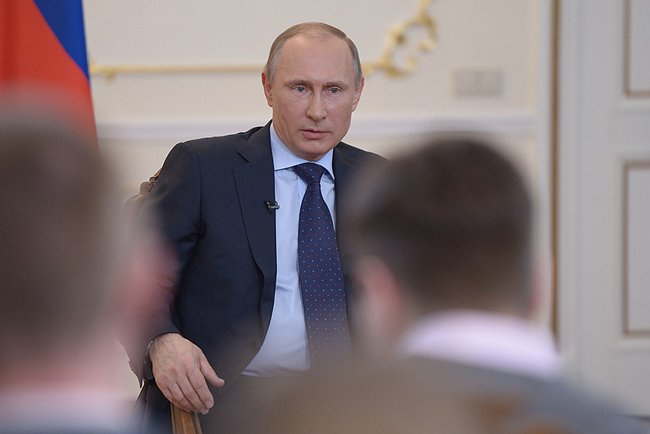
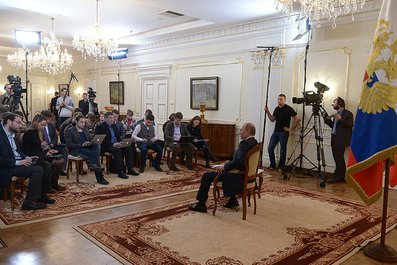
4/3/2014, Encontro com jornalistas, Kremlin (texto transcrito)
http://eng.news.kremlin.ru/news/6763


[continuação]

VLADIMIR PUTIN, PRESIDENTE DA RÚSSIA: Suas perguntas, por favor.

PERGUNTA: Sr. Presidente, pode dizer se o senhor esperava reação tão forte dos seus parceiros ocidentais, contra as ações da Rússia? Pode dar-nos detalhes de suas conversas com seus parceiros ocidentais? A única coisa que se ouviu foram notícias do seu serviço de imprensa. E o que pensa sobe a reunião do G8 em Sochi – acontecerá?

VLADIMIR PUTIN: Sobre a reação esperada, se o G8 se realizará e sobre as conversas. Todas essas conversas são confidenciais, algumas acontecem até por linhas protegidas. Assim sendo, não estou autorizado a divulgar o que discuti com os parceiros. Mas posso comentar algumas declarações públicas, feitas por meus colegas ocidentais; sem dar nomes; comento-as só em termos gerais.

A que prestar atenção? Sempre há alguém a dizer que o que a Rússia faz não seria ilegítimo. Pergunto: “Será que supõem que tudo que o que eles fazem é sempre legítimo?” A resposta é “Sim, eles supõem”. Então, tenho de lembrar-lhes o que os EUA fizeram no Afeganistão, Iraque e Líbia, onde agiram sem autorização da ONU ou distorceram completamente o conteúdo daquelas resoluções, como no caso da Líbia. Nesse caso, como vocês sabem, a resolução só autorizava a fechar o espaço aéreo para a aviação de Gaddafi. E a coisa terminou, como se sabe, com bombardeios aéreos e operação em terra, pelas forças especiais.

O que se vê é que nossos parceiros, especialmente os EUA, sempre claramente formular seus próprios interesses geopolíticos e de estado, e os seguem persistentemente. Então, usando o princípio “Ou estão conosco ou estão contra nós”, dividem o mundo. E os que não se enquadrem, são ‘espancados’ até se enquadrar.

Nossa abordagem é diferente. Partimos da convicção de que sempre temos de agir com legitimidade. Eu, pessoalmente, sempre defendi que temos de agir em estrito cumprimento da lei internacional. Quero reforçar, mais uma vez, que, se tomarmos a decisão, se eu decidir usar as Forças Armadas russas, será decisão legítima, em plena obediência a todas as normas gerais da lei internacional – porque recebemos um pedido de ajuda do presidente legítimo –, e, também, em plena obediência aos nossos compromissos, que, nesse caso, coincidem com nossos interesses de proteger um povo com o qual temos estreitos laços históricos, culturais e econômicos. Essa é missão humanitária. Não visamos a subjugar ninguém nem a dar ordens a ninguém. Mas não podemos ficar indiferentes se vemos aquele povo ser perseguido, destruído e humilhado.

Seja como for, espero sinceramente que não seja necessário chegar até isso.

PERGUNTA: Como o senhor avalia a reação do ocidente aos eventos na Ucrânia e as ameaças contra a Rússia: estamos diante de possíveis sanções ou da expulsão do G8?

VLADIMIR PUTIN: Quanto às sanções. Quem mais se deve preocupar com as consequências das sanções é quem aplica as sanções. Entendo que, no mundo moderno, no qual tudo está interconectado e é interdependente, é possível causar danos a outro país, mas sempre será dano mútuo. Aí está algo que todos devem manter sempre em mente. Isso é uma coisa.

A segunda coisa, e a mais importante: já disse aos senhores o que nos motiva. Mas... o que motiva nossos parceiros? Eles apoiaram um golpe para tomada armada e inconstitucional do poder; declararam o novo poder legítimo e agora estão tentando dar-lhes apoio.

Devo dizer que, apesar de tudo isso, temos sido pacientes e até dispostos a cooperar; não queremos romper nossa cooperação. Como vocês devem saber, há alguns dias instruí o governo a considerar como se podem preservar os contatos até com aqueles poderes em Kiev que não consideramos legítimos, para não comprometer nossos laços na economia e na indústria. Entendemos que nossas ações têm sido absolutamente razoáveis. Entendemos também que ameaçar a Rússia sempre é contraproducente e danoso.

Quanto ao G8, não sei. Estaremos prontos para hospedar o encontro com nossos colegas. Se não querem vir... que seja.

PERGUNTA: Posso acrescentar algo, sobre os contatos? Como vejo as coisas, o senhor considera legítimo o primeiro-ministro da Crimeia, sr. Aksyonov, como representante das autoridades do governo. O senhor está pronto a ter contatos com os que se consideram legítimas autoridades em Kiev?

VLADIMIR PUTIN: Já falei sobre isso. O senhor talvez não tenha ouvido.

PERGUNTA: Quero dizer, em alto nível, para uma solução política.

VLADIMIR PUTIN: Não parceiro no alto nível, lá. Lá não há presidente. E não pode haver, até que haja eleições gerais.

Quanto à Crimeia, o Parlamento foi formado em 2010, em dezembro de 2010, se bem me lembro. Há 100 deputados eleitos, que representam seis partidos políticos. Depois da renúncia do ex-primeiro-ministro, o Parlamento da Crimeia, como ordena a legislação vigente e pelos procedimentos legais, elegeram um novo primeiro-ministro em sessão do Conselho Superior da Crimeia. É claro que é definitivamente legítimo. Foram respeitados todos os procedimentos de lei; não houve sequer um ato ilegal.

E, quando há alguns dias, um grupo de homens armados tentou ocupar o prédio do Soviet Superior da Crimeia, houve indignação dos habitantes locais. Pareceu-lhes que alguém tentava aplicar na Crimeia o mesmo cenário de Kiev, lançar séries de atos terroristas e provocar o caos. É claro que os habitantes locais têm boas razões para preocupação. Por isso organizaram comitês de autodefesa e assumiram o controle sobre as forças armadas da Crimeia.

Casualmente, examinei as notícias, ontem, para ver sobre o que, exatamente, a população da Crimeia assumiu o controle. Há várias dúzias de unidades C-300, várias dúzias de sistemas de mísseis de defesa aérea, 22 mil soldados e mais. Mas, como eu disse, tudo já está sob controle do povo da Crimeia, e sem disparar um único tiro.

PERGUNTA: Sr. Presidente, um esclarecimento, por favor. As pessoas que bloqueavam o acesso às unidades do Exército da Crimeia usavam uniformes muito parecidos com o uniforme do Exército Russo. Eram soldados russos, o exército russo?

VLADIMIR PUTIN: Examine os uniformes dos exércitos dos soldados dos estados pós-soviéticos. Há muitos uniformes parecidos. E sempre se pode entrar numa loja e comprar qualquer tipo de fardamento.

PERGUNTA: Mas eram ou não eram soldados russos?

VLADIMIR PUTIN: Eram unidades locais de autodefesa.

PERGUNTA: Eram treinados? Se se comparam aqueles soldados com as unidades de autodefesa em Kiev…

VLADIMIR PUTIN: Meu caro amigo, veja o quão bem treinado era o pessoal que operou em Kiev. Todos sabemos que foram treinados em bases especiais em estados vizinhos: na Lituânia, na Polônia e na própria Ucrânia. Foram treinados por instrutores, por longos períodos. Foram divididos em dúzias e centenas, as ações foram coordenadas e havia bons sistemas de comunicação. Funcionava como um relógio. Você os viu em ação? Operavam como profissionais, pareciam forças especiais. Por que você pressupõe que os defensores da Crimeia teriam de ser menos bem organizados, piores?

PERGUNTA: Então, me explico melhor: tomamos parte no treinamento das forças de autodefesa da Crimeia?

VLADIMIR PUTIN: Não.

PERGUNTA: Como o senhor vê o futuro da Crimeia? O senhor considera a possibilidade de a Crimeia unir-se à Rússia?

VLADIMIR PUTIN: Não, não consideramos. De modo geral, creio que só residentes de um determinado país, com plena liberdade para escolher e em completa segurança, podem determinar o futuro do próprio país. Se isso sempre tivesse sido garantido aos albaneses do Kosovo, se fosse tornado possível em muitas diferentes partes do mundo, ninguém teria roubado a ninguém o direito à autodeterminação, o qual, que eu saiba, está fixado em vários documentos da ONU. Não, de modo algum. Não provocaremos essa decisão, nem promoveremos esses sentimentos.

Quero destacar que acredito que só quem viva num dado território tem o direito de determinar o próprio destino naquele território.

PERGUNTA: Duas perguntas. O senhor disse que enviar tropas à Ucrânia é medida extrema, mas o senhor não a descartou. Mas, se tropas russas entrarem na Ucrânia, pode ser o início de uma guerra. Isso não o preocupa?

E uma segunda pergunta: o senhor diz que Yanukovych não deu ordem para seus policiais atirarem contra o povo. Mas alguém atirou e, claramente, eram atiradores treinados.

VLADIMIR PUTIN: Muita gente, inclusive pessoas que estavam entre os manifestantes, manifestaram a opinião de que eram provocadores, de um dos partidos da oposição. O senhor não ouviu esses relatos?

RESPOSTA: Não, não ouvi.

VLADIMIR PUTIN: Procure esses relatos – não é difícil encontrá-los. Por isso é tão difícil chegar ao fundo dessa situação. Mas não há dúvidas de que o senhor e eu vimos, com certeza, quando os policiais Berkut lá estavam, só com seus escudos, sob fogo – e não eram armas de ar comprimido, que foram usadas contra eles, mas armas de assalto, que perfuraram os escudos. Isso, com certeza, nós vimos, todo mundo viu. E quanto a quem ordenou os tiros, não sei. Sei o que o sr. Yanukovych contou-me. E ele me disse que não deu ordem de tiro, em nenhum momento. Mais do que isso, depois de assinar o acordo de 21/2, ele deu instruções para que todas as unidades policiais se retirassem da capital.

Posso, até, lhe contar mais. Yanukovych telefonou-me; e eu lhe disse que não retirasse os policiais das ruas. Disse a ele “Você terá anarquia, você gerará o caos na capital. Pense no povo.” Mas, mesmo assim, ele retirou os policiais. Imediatamente seu próprio gabinete foi tomado, e o prédio do governo, e foi o caos, o mesmo do qual eu falei a Yanukovych, e que continua até hoje.

PERGUNTA: E sobre a primeira pergunta? Não o preocupa a possibilidade de uma guerra?

VLADIMIR PUTIN: Não. Porque não planejamos guerra alguma, nem combateremos contra o povo da Ucrânia.

PERGUNTA: Mas há soldados ucranianos, o exército ucraniano.

VLADIMIR PUTIN: Ouça com atenção. Quero que me compreendam claramente: se nós tomarmos essa decisão, será, sempre e necessariamente e unicamente, para proteger os cidadãos da Ucrânia. Quero ver que exército ucraniano se atreverá a atirar contra o próprio povo, com os russos lá, com os ucranianos; por trás dos ucranianos, não à frente, mas no apoio. Queria saber quem, na Ucrânia, daria ordem ao exército ucraniano para atirar contra mulheres e criança ucranianas que estão sob nossa proteção.

PERGUNTA: Posso fazer uma pergunta, sr. presidente? Nossos colegas, meus colegas jornalistas que estão atualmente trabalhando na Ucrânia, dizem, todos os dias, que a situação dos Berkut piora dia a dia (com exceção, talvez, da Crimeia). Em Kiev, especialmente, há oficiais da polícia antitumultos feridos, agora hospitalizados, mas que não recebem nenhum tipo de tratamento. Alguns, sequer recebem comida. E as famílias deles não podem nem sair de casa, porque estão cercados: há barricadas em torno das casas. Não têm comida, são humilhados. O senhor pode comentar isso? Há meio de a Rússia ajudar aquelas famílias e os policiais?

VLADIMIR PUTIN: Sim, é assunto que muito nos preocupa. Não são soldados nossos, nem estamos diretamente envolvidos nessa situação. Mas é, sim, uma questão humanitária grave. Seria oportuno que nossas organizações de direitos humanos se envolvessem nessa questão. Podemos pedir que Vladimir Lukin, só ou com seus colegas [da ONU], representantes da França, Alemanha e Polônia, que trabalharam para construir o conhecido acordo de 21/2/2014, que viajem até lá e verifiquem in loco a situação desses policiais Berkut, que não ofenderam nenhuma lei e agiram em obediência às ordens. São oficiais militares, enfrentaram os tiros, os coquetéis molotov, foram feridos. Aquela situação é difícil até de imaginar. Há leis que obrigam a alimentar e dar tratamento médico até a prisioneiros de guerra. As organizações de direitos humanos devem dar toda a atenção a esse caso. Desde já, garanto que receberão atendimento médico aqui na Rússia.

PERGUNTA: Sr. Presidente, voltando à reação ocidental. Depois do duro pronunciamento do secretário de Estado dos EUA, o Conselho da Federação sugeriu que chamássemos de volta nosso embaixador nos EUA. O senhor apoia essa ideia?

VLADIMIR PUTIN: O secretário de Estado dos EUA é, sem dúvida, homem muito importante, mas não é a autoridade que determina a política externa dos EUA. Ouvimos declarações de vários políticos e representantes de variadas forças políticas. A medida sugerida é medida extrema. Será usada, se for necessária. Mas realmente não quero usá-la, porque acho que a Rússia não é a única interessada na cooperação com nossos parceiros num plano internacional, e em áreas como economia, política e segurança internacional, a cooperação interessa tanto a nossos parceiros quanto a nós. É muito fácil destruir esses instrumentos de cooperação, e seria muito difícil reconstruí-los.

PERGUNTA: Rússia envolveu-se no destino de Yanukovych. Como o senhor vê seu papel futuro e seu destino futuro?

VLADIMIR PUTIN: É difícil dizer, não analisei detidamente essas questões. Acho que ele não tem nenhum futuro político – e disse a ele. Quanto a nos ter envolvido no “destino” dele – o que fizemos foi feito por questão de consideração humanitária. Assassinar presidente legítimo é o meio mais fácil para livrar-se dele. Acho que, se ficasse lá, teria sido assassinado. Mais uma vez, ressurge a mesma pergunta: mas por quê?

Afinal, vejam como tudo começou, o que desencadeou esses eventos. A razão formal é que ele não assinou o Tratado de Associação com a União Europeia. Hoje, já soa como total nonsense; é ridículo, até, falar disso. Mas o que quero dizer é que ele não se recusou a assinar o tal Tratado.

Yanukovych disse: “Analisamos detidamente esse Tratado e o conteúdo dele não atende aos nossos interesses nacionais. Não podemos aumentar o preço do combustível para os ucranianos, tanto quanto o Tratado exige, porque os ucranianos já vivem situação muito difícil. Não podemos fazer isso, nem isso, nem aquilo. Não podemos romper completamente e imediatamente nossos laços econômicos com a Rússia, porque nossa cooperação é muito extensa. (...) Yanukovych disse “Não posso fazer isso, assim, de repente. Vamos discutir mais.” Yanukovych não se recusou a assinar o Tratado: só pediu mais tempo para discutir o documento. E, na sequência, essa loucura toda começou.

E por quê? Teria feito algo que extrapolasse a autoridade que tinha? Não. Agiu estritamente no limite de sua autoridade; não infringiu lei alguma. Simplesmente se recusou a apoiar as forças que lhe faziam oposição, numa luta pelo poder. Nada há aí de excepcional. Como, por que, esse ‘nada’ inicial foi levado ao atual nível de anarquia, à derrubada ilegal de governo legítimo, com a Ucrânia lançada no caos em que está hoje? Tudo, aí, me parece inaceitável.

Não é a primeira vez que nossos parceiros ocidentais fazem isso na Ucrânia. Às vezes tenho a sensação de que em algum lugar naquele poço imenso, nos EUA, alguém senta-se num laboratório e põe-se a fazer testes, como se todos fôssemos ratos de gaiola, sem realmente compreender as consequências do que fazem. Por que tinham de fazer isso? Quem explica o que fizeram? Não há explicação.

O mesmo aconteceu durante o primeiro levante na praça Maidan, quando Yanukovych foi bloqueado longe do poder. Quem precisava daquele terceiro turno de eleições? Em outras palavras, a coisa toda virou farsa – a vida política da Ucrânia foi convertida em farsa. Nenhuma consideração à Constituição. Agora, vocês veem, estão ensinando às pessoas que, se uma pessoa pode violar a lei, todos podem; assim, geraram o caos. O perigo é esse.

Em vez disso, é preciso ensinar as sociedades a seguir outras tradições: a tradição de respeitar a lei maior do país, a Constituição, e todas as demais leis. Claro, nem sempre se conseguirá. Mas... agir como touro em loja de porcelana é contraproducente e muito perigoso. Há mais perguntas, por favor? [Continua]

Vladimir Putin answered journalists’ questions on the situation in Ukraine - President of Russia Website´s

President of Russia  Website´s


The President of Russia met with media representatives to answer a number of their questions, in particular with regard to the situation in Ukraine.
PRESIDENT OF RUSSIA VLADIMIR PUTIN: Good afternoon, colleagues,
How shall we do this? This is what I’d like to suggest: let’s have a conversation, rather than an interview. Therefore, I would ask you to begin by stating all your questions, I will jot them down and try to answer them, and then we will have a more detailed discussion of the specifics that interest you most.
Let’s begin.
QUESTION: Mr President, I would like to ask (you took a lengthy pause, so we have quite a few questions by now) how you assess the events in Kiev? Do you think that the Government and the Acting President, who are currently in power in Kiev, are legitimate? Are you ready to communicate with them, and on what terms? Do you yourself think it possible now to return to the agreements of February 21, which we all talk about so often?
QUESTION: Mr President, Russia has promised financial aid to Crimea and instructions were issued to the Finance Ministry yesterday. Is there a clear understanding of how much we are giving, where the money is coming from, on what terms and when? The situation there is very difficult.
QUESTION: When, on what terms and in what scope can military force be used in Ukraine? To what extent does this comply with Russia’s international agreements? Did the military exercises that have just finished have anything to do with the possible use of force?
QUESTION: We would like to know more about Crimea. Do you think that the provocations are over or that there remains a threat to the Russian citizens who are now in Crimea and to the Russian-speaking population? What are the general dynamics there – is the situation changing for the better or for the worse? We are hearing different reports from there.
QUESTION: If you do decide to use force, have you thought through all the possible risks for yourself, for the country and for the world: economic sanctions, weakened global security, a possible visa ban or greater isolation for Russia, as western politicians are demanding?
QUESTION: Yesterday the Russian stock market fell sharply in response to the Federation Council’s vote, and the ruble exchange rates hit record lows. Did you expect such a reaction? What do you think are the possible consequences for the economy? Is there a need for any special measures now, and of what kind? For instance, do you think the Central Bank’s decision to shift to a floating ruble exchange rate may have been premature? Do you think it should be revoked? 
VLADIMIR PUTIN: Fine, let us stop here for now. I will begin, and then we will continue. Don’t worry; I will try to answer as many questions as possible.
First of all, my assessment of what happened in Kiev and in Ukraine in general. There can only be one assessment: this was an anti-constitutional takeover, an armed seizure of power. Does anyone question this? Nobody does. There is a question here that neither I, nor my colleagues, with whom I have been discussing the situation in Ukraine a great deal over these past days, as you know – none of us can answer. The question is why was this done?
I would like to draw your attention to the fact that President Yanukovych, through the mediation of the Foreign Ministers of three European countries – Poland, Germany and France – and in the presence of my representative (this was the Russian Human Rights Commissioner Vladimir Lukin) signed an agreement with the opposition on February 21. I would like to stress that under that agreement (I am not saying this was good or bad, just stating the fact) Mr Yanukovych actually handed over power. He agreed to all the opposition’s demands: he agreed to early parliamentary elections, to early presidential elections, and to return to the 2004 Constitution, as demanded by the opposition. He gave a positive response to our request, the request of western countries and, first of all, of the opposition not to use force. He did not issue a single illegal order to shoot at the poor demonstrators. Moreover, he issued orders to withdraw all police forces from the capital, and they complied. He went to Kharkov to attend an event, and as soon as he left, instead of releasing the occupied administrative buildings, they immediately occupied the President’s residence and the Government building – all that instead of acting on the agreement.
I ask myself, what was the purpose of all this? I want to understand why this was done. He had in fact given up his power already, and as I believe, as I told him, he had no chance of being re-elected. Everybody agrees on this, everyone I have been speaking to on the telephone these past few days. What was the purpose of all those illegal, unconstitutional actions, why did they have to create this chaos in the country? Armed and masked militants are still roaming the streets of Kiev. This is a question to which there is no answer. Did they wish to humiliate someone and show their power? I think these actions are absolutely foolish. The result is the absolute opposite of what they expected, because their actions have significantly destabilised the east and southeast of Ukraine.
Now over to how this situation came about.
In my opinion, this revolutionary situation has been brewing for a long time, since the first days of Ukraine’s independence.  The ordinary Ukrainian citizen, the ordinary guy suffered during the rule of Nicholas II, during the reign of Kuchma, and Yushchenko, and Yanukovych. Nothing or almost nothing has changed for the better. Corruption has reached dimensions that are unheard of here in Russia. Accumulation of wealth and social stratification – problems that are also acute in this country – are much worse in Ukraine, radically worse. Out there, they are beyond anything we can imagine. Generally, people wanted change, but one should not support illegal change.
Only constitutional means should be used on the post-Soviet space, where political structures are still very fragile, and economies are still weak. Going beyond the constitutional field would always be a cardinal mistake in such a situation.  Incidentally, I understand those people on Maidan, though I do not support this kind of turnover. I understand the people on Maidan who are calling for radical change rather than some cosmetic remodelling of power. Why are they demanding this? Because they have grown used to seeing one set of thieves being replaced by another. Moreover, the people in the regions do not even participate in forming their own regional governments. There was a period in this country when the President appointed regional leaders, but then the local legislative authorities had to approve them, while in Ukraine they are appointed directly. We have now moved on to elections, while they are nowhere near this. And they began appointing all sorts of oligarchs and billionaires to govern the eastern regions of the country. No wonder the people do not accept this, no wonder they think that as a result of dishonest privatisation (just as many people think here as well) people have become rich and now they also have been brought to power.
For example, Mr Kolomoisky was appointed Governor of Dnepropetrovsk. This is a unique crook. He even managed to cheat our oligarch Roman Abramovich two or three years ago.  Scammed him, as our intellectuals like to say. They signed some deal, Abramovich transferred several billion dollars, while this guy never delivered and pocketed the money. When I asked him [Abramovich]: “Why did you do it?” he said: “I never thought this was possible.” I do not know, by the way, if he ever got his money back and if the deal was closed.  But this really did happen a couple of years ago. And now this crook is appointed Governor of Dnepropetrovsk. No wonder the people are dissatisfied. They were dissatisfied and will remain so if those who refer to themselves as the legitimate authorities continue in the same fashion.
Most importantly, people should have the right to determine their own future, that of their families and of their region, and to have equal participation in it. I would like to stress this: wherever a person lives, whatever part of the country, he or she should have the right to equal participation in determining the future of the country.
Are the current authorities legitimate? The Parliament is partially, but all the others are not. The current Acting President is definitely not legitimate. There is only one legitimate President, from a legal standpoint. Clearly, he has no power. However, as I have already said, and will repeat: Yanukovych is the only undoubtedly legitimate President.
There are three ways of removing a President under Ukrainian law: one is his death, the other is when he personally steps down, and the third is impeachment. The latter is a well-deliberated constitutional norm. It has to involve the Constitutional Court, the Supreme Court and the Rada. This is a complicated and lengthy procedure. It was not carried out.  Therefore, from a legal perspective this is an undisputed fact.
Moreover, I think this may be why they disbanded the Constitutional Court, which runs counter to all legal norms of both Ukraine and Europe. They not only disbanded the Constitutional Court in an illegitimate fashion, but they also – just think about it – instructed the Prosecutor General’s Office to launch criminal proceedings against members of the Constitutional Court. What is that all about? Is this what they call free justice? How can you instruct anyone to start criminal proceedings? If a crime, a criminal offence, has been committed, the law enforcement agencies see this and react. But instructing them to file criminal charges is nonsense, it’s monkey business.
Now about financial aid to Crimea. As you may know, we have decided to organise work in the Russian regions to aid Crimea, which has turned to us for humanitarian support. We will provide it, of course. I cannot say how much, when or how – the Government is working on this, by bringing together the regions bordering on Crimea, by providing additional support to our regions so they could help the people in Crimea. We will do it, of course.
Regarding the deployment of troops, the use of armed forces.  So far, there is no need for it, but the possibility remains. I would like to say here that the military exercises we recently held had nothing to do with the events in Ukraine.  This was pre-planned, but we did not disclose these plans, naturally, because this was a snap inspection of the forces’ combat readiness. We planned this a long time ago, the Defence Minister reported to me and I had the order ready to begin the exercise. As you may know, the exercises are over; I gave the order for the troops to return to their regular dislocations yesterday.
What can serve as a reason to use the Armed Forces? Such a measure would certainly be the very last resort.
First, the issue of legitimacy. As you may know, we have a direct appeal from the incumbent and, as I said, legitimate President of Ukraine, Mr Yanukovych, asking us to use the Armed Forces to protect the lives, freedom and health of the citizens of Ukraine.
What is our biggest concern? We see the rampage of reactionary forces, nationalist and anti-Semitic forces going on in certain parts of Ukraine, including Kiev. I am sure you, members of the media, saw how one of the governors was chained and handcuffed to something and they poured water over him, in the cold of winter. After that, by the way, he was locked up in a cellar and tortured. What is all this about? Is this democracy? Is this some manifestation of democracy? He was actually only recently appointed to this position, in December, I believe. Even if we accept that they are all corrupt there, he had barely had time to steal anything.
And do you know what happened when they seized the Party of Regions building? There were no party members there at all at the time. Some two-three employees came out, one was an engineer, and he said to the attackers: “Could you let us go, and let the women out, please. I’m an engineer, I have nothing to do with politics.” He was shot right there in front of the crowd. Another employee was led to a cellar and then they threw Molotov cocktails at him and burned him alive.  Is this also a manifestation of democracy?
When we see this we understand what worries the citizens of Ukraine, both Russian and Ukrainian, and the Russian-speaking population in the eastern and southern regions of Ukraine. It is this uncontrolled crime that worries them. Therefore, if we see such uncontrolled crime spreading to the eastern regions of the country, and if the people ask us for help, while we already have the official request from the legitimate President, we retain the right to use all available means to protect those people. We believe this would be absolutely legitimate. This is our last resort.
Moreover, here is what I would like to say: we have always considered Ukraine not only a neighbour, but also a brotherly neighbouring republic, and will continue to do so. Our Armed Forces are comrades in arms, friends, many of whom know each other personally. I am certain, and I stress, I am certain that the Ukrainian military and the Russian military will not be facing each other, they will be on the same side in a fight.
Incidentally, the things I am talking about – this unity – is what is happening in Crimea. You should note that, thank God, not a single gunshot has been fired there; there are no casualties, except for that crush on the square about a week ago. What was going on there? People came, surrounded units of the armed forces and talked to them, convincing them to follow the demands and the will of the people living in that area. There was not a single armed conflict, not a single gunshot.
Thus the tension in Crimea that was linked to the possibility of using our Armed Forces simply died down and there was no need to use them. The only thing we had to do, and we did it, was to enhance the defence of our military facilities because they were constantly receiving threats and we were aware of the armed nationalists moving in. We did this, it was the right thing to do and very timely. Therefore, I proceed from the idea that we will not have to do anything of the kind in eastern Ukraine.
There is something I would like to stress, however. Obviously, what I am going to say now is not within my authority and we do not intend to interfere. However, we firmly believe that all citizens of Ukraine, I repeat, wherever they live, should be given the same equal right to participate in the life of their country and in determining its future.
If I were in the shoes of those who consider themselves the legitimate authorities, I would not waste time and go through all the necessary procedures, because they do not have a national mandate to conduct the domestic, foreign and economic policy of Ukraine, and especially to determine its future.
Now, the stock market. As you may know, the stock market was jumpy even before the situation in Ukraine deteriorated. This is primarily linked to the policy of the US Federal Reserve, whose recent decisions enhanced the attractiveness of investing in the US economy and investors began moving their funds from the developing markets to the American market. This is a general trend and it has nothing to do with Ukraine. I believe it was India that suffered most, as well as the other BRICS states. Russia was hit as well, not as hard as India, but it was. This is the fundamental reason.
As for the events in Ukraine, politics always influence the stock market in one way or another. Money likes quiet, stability and calm. However, I think this is a tactical, temporary development and a temporary influence.
Your questions, please.
QUESTION: Mr President, can you tell us if you expected such a harsh reaction to Russia’s actions from your western partners? Could you give us any details of your conversations with your western partners? All we’ve heard was a report from the press service. And what do you think about the G8 summit in Sochi – will it take place?
VLADIMIR PUTIN: Regarding the expected reaction, whether the G8 will meet and about the conversations. Our conversations are confidential, some are even held over secure lines. Therefore, I am not authorised to disclose what I discussed with my partners. I will, however, refer to some public statements made by my colleagues from the west; without giving any names, I will comment on them in a general sense.
What do we pay attention to? We are often told our actions are illegitimate, but when I ask, “Do you think everything you do is legitimate?” they say “yes”. Then, I have to recall the actions of the United States in Afghanistan, Iraq and Libya, where they either acted without any UN sanctions or completely distorted the content of such resolutions, as was the case with Libya. There, as you may know, the resolution only spoke of closing the airspace for government aircraft, while it all ended with bomb attacks and special forces land operations.
Our partners, especially in the United Sates, always clearly formulate their own geopolitical and state interests and follow them with persistence. Then, using the principle “You’re either with us or against us” they draw the whole world in. And those who do not join in get ‘beaten’ until they do.
Our approach is different. We proceed from the conviction that we always act legitimately. I have personally always been an advocate of acting in compliance with international law. I would like to stress yet again that if we do make the decision, if I do decide to use the Armed Forces, this will be a legitimate decision in full compliance with both general norms of international law, since we have the appeal of the legitimate President, and with our commitments, which in this case coincide with our interests to protect the people with whom we have close historical, cultural and economic ties. Protecting these people is in our national interests. This is a humanitarian mission. We do not intend to subjugate anyone or to dictate to anyone. However, we cannot remain indifferent if we see that they are being persecuted, destroyed and humiliated. However, I sincerely hope it never gets to that.
QUESTION: How do you asses the reaction of the west to the events in Ukraine and their threats regarding Russia: are we facing the possibility of sanctions or withdrawal from the G8?
VLADIMIR PUTIN: Regarding sanctions. It is primarily those who intend to apply them that need to consider their consequences. I believe that in the modern world, where everything is interconnected and interdependent, it is possible to cause damage to another country, but this will be mutual damage and one should bear this in mind.  This is one thing.
The second and the most important thing. I have already told you what motivates us.  And what motivates our partners? They supported an unconstitutional armed take-over, declared these people legitimate and are trying to support them. By the way, despite all of this we have been patient and even ready to cooperate; we do not want to disrupt our cooperation. As you may know, a few days ago I instructed the Government to consider how we can maintain contacts even with those powers in Kiev that we do not consider legitimate in order to retain our ties in the economy and industry. We think our actions have been absolutely reasonable, while any threat against Russia is counterproductive and harmful.
As for the G8, I do not know. We will be ready to host the summit with our colleagues. If they do not want to come – so be it.
QUESTION: Can I add about contacts? The way I see it, you consider the Prime Minister of Crimea Mr Aksyonov to be a legitimate representative of government authorities. Are you ready to have any contacts with those who consider themselves the legitimate authorities in Kiev?
VLADIMIR PUTIN: I have just spoken about it. You must have missed it.
QUESTION: I mean, at the top level for a political solution.
VLADIMIR PUTIN: I do not have a partner at the top level there. There is no president there, and there cannot be one until the general elections.
As for Crimea, the Parliament there was formed in 2010, in December 2010 if I remember correctly. There are 100 MPs representing six political parties. After the previous Prime Minister resigned, the Crimean Parliament, in compliance with the existing legislation and procedures elected a new Prime Minister at a session of the Crimean Supreme Council. He is definitely legitimate.  They have complied with all the procedures envisaged by the law; there is not a single violation. However, when a few days ago a group of armed men tried to occupy the building of the Crimean Supreme Soviet, this caused the concern of the local residents. It seemed as though someone wanted to apply the Kiev scenario in Crimea and to launch a series of terrorist attacks and cause chaos. Naturally, this causes grave concern among the local residents. That is why they set up self-defence committees and took control over all the armed forces.
Incidentally, I was studying the brief yesterday to see what they took over – it is like a fortified zone. There are several dozen C-300 units, several dozen air-defence missile systems, 22,000 service members and a lot more.  However, as I said, this is all in the hands of the people of Crimea and without a single gunshot.
QUESTION: Mr President, a clarification if I may. The people who were blocking the Ukrainian Army units in Crimea were wearing uniforms that strongly resembled the Russian Army uniform. Were those Russian soldiers, Russian military?
VLADIMIR PUTIN: Why don’t you take a look at the post-Soviet states. There are many uniforms there that are similar. You can go to a store and buy any kind of uniform.
QUESTION: But were they Russian soldiers or not?
VLADIMIR PUTIN: Those were local self-defence units.
QUESTION: How well trained are they? If we compare them to the self-defence units in Kiev…
VLADIMIR PUTIN: My dear colleague, look how well trained the people who operated in Kiev were. As we all know they were trained at special bases in neighbouring states: in Lithuania, Poland and in Ukraine itself too. They were trained by instructors for extended periods. They were divided into dozens and hundreds, their actions were coordinated, they had good communication systems. It was all like clockwork.  Did you see them in action? They looked very professional, like special forces. Why do you think those in Crimea should be any worse?
QUESTION: In that case, can I specify: did we take part in training Crimean self-defence forces?
VLADIMIR PUTIN: No, we did not.
QUESTION: How do you see the future of Crimea? Do you consider the possibility of it joining Russia?
VLADIMIR PUTIN: No, we do not. Generally, I believe that only residents of a given country who have the freedom of will and are in complete safety can and should determine their future. If this right was granted to the Albanians in Kosovo, if this was made possible in many different parts of the world, then nobody has ruled out the right of nations to self-determination, which, as far as I know, is fixed by several UN documents.  However, we will in no way provoke any such decision and will not breed such sentiments.
I would like to stress that I believe only the people living in a given territory have the right to determine their own future.
QUESTION: Two questions. You said that sending troops into Ukraine is an extreme measure, but you are nevertheless not ruling it out. Still, if Russian troops enter Ukraine, it could start a war. Doesn’t that bother you?
 And a second question. You say that Yanukovych did not give the order to shoot people. But somebody shot at the protestors. And clearly, these were snipers, trained snipers.
VLADIMIR PUTIN: You know, some people, including those who were recently among the protestors, have expressed the opinion that these were provocateurs from one of the opposition parties. Have you heard this?
REPLY: No, I have not heard this.
VLADIMIR PUTIN: Look at these materials – they are freely available. That is why it is very difficult to get to the bottom of the situation. But you and I saw for ourselves when the Berkut fighters stood there with their shields and were shot at – and those were not air weapons that were used against them but assault weapons that pierced their shields. That is something we saw for certain. As for who gave the orders – that I do not know. I only know what Mr Yanukovych told me. And he told me that he did not give any orders, and moreover, he gave instructions – after signing a corresponding agreement – to even withdraw all militia units from the capital.
If you want, I can tell you even more. He called me on the phone and I told him not to do it. I said, “You will have anarchy, you will have chaos in the capital. Think about the people.” But he did it anyway. And as soon as he did it, his office was seized, and that of the government, and the chaos I had warned him about and which continues to this day, erupted.
QUESTION: What about the first question? Are you concerned that a war could break out?
VLADIMIR PUTIN: I am not concerned, because we do not plan and we will not fight with the Ukrainian people.
QUESTION: But there are Ukrainian troops, there is the Ukrainian army.
VLADIMIR PUTIN: Listen carefully. I want you to understand me clearly: if we make that decision, it will only be to protect Ukrainian citizens. And let’s see those troops try to shoot their own people, with us behind them – not in the front, but behind. Let them just try to shoot at women and children! I would like to see those who would give that order in Ukraine.
QUESTION: Can I ask a question, Mr President? Our colleagues, my colleagues, who are currently working in Ukraine, are saying practically every day that the situation for the Berkut fighters is only getting worse (perhaps with the exception of Crimea). In particular, in Kiev, there are injured Berkut officers who are in hospitals now, where nobody is treating them and they are not even getting fed. And their families, including elderly family members, they simply cannot leave the house, because they are not being allowed; there are barricades all around, they are being humiliated. Can you comment on this? And can Russia help these families and colleagues?
VLADIMIR PUTIN: Yes, this issue is of great concern to us. After all, these are not Russia’s Interior Ministry officers, and we were not managing the situation there. But out of humanitarian considerations, it would be good if our human rights organisations got involved in this as well; we might ask Vladimir Lukin, either alone or together with his colleagues, representatives from France, Germany and Poland, with whom he participated in developing the well-known document of February 21, 2014, to go on location and see what is happening there with these Berkut officers, who have not broken any laws and acted in accordance with their orders. They are military service members, they stood there facing bullets, they were doused with fire and had Molotov cocktails thrown at them. They have been wounded and injured and are now in a hospital. It is even hard to imagine – even prisoners of war are being fed and treated. But they not only stopped treating them, they even stopped feeding them. And they have surrounded the building where these fighters’ families live and are bullying them. I think that human rights organisations must pay attention to this. And we, for our part, are ready to provide them with medical care here in Russia.
QUESTION: Mr President, getting back to the West’s reaction. Following the US Secretary of State’s harsh statement, the Federation Council suggested that we recall our ambassador to the United States. Do you support this idea?
VLADIMIR PUTIN: The US Secretary of State is certainly an important person, but he is not the ultimate authority that determines the United States’ foreign policy. We hear statements from various politicians and representatives of various political forces. This would be an extreme measure. If necessary, it will be used. But I really don’t want to use it, because I think Russia is not the only one interested in cooperation with its partners on an international level and in such areas as economy, politics and foreign security; our partners are just as interested in this cooperation. It is very easy to destroy these instruments of cooperation and it would be very difficult to rebuild them.
QUESTION: Russia got involved in Yanukovych’s fate. How do you see his future role and his future destiny?
VLADIMIR PUTIN: You know, it is very hard for me to say; I have not analysed it carefully. I think he has no political future, and I have told him so. As for “getting involved in his fate” – we did this on purely humanitarian grounds. Death is the easiest way for getting rid of a legitimate president, and I think that is what would have happened. I think they would have simply killed him. Incidentally, the question arises: what for?
After all, look at how it all began, what triggered these events. The formal reason was that he did not sign the European Union Association Agreement. Today, this seems like nonsense; it is ridiculous to even talk about. But I want to point out that he did not refuse to sign the association agreement. He said: “We have carefully analysed it, and its content does not correspond with our national interests. We cannot sharply increase energy prices for our people, because our people are already in a rather difficult position. We cannot do this, and that, and that. We cannot immediately break our economic ties with Russia, because our cooperation is very extensive.”
I have already presented these figures: out of approximately 14 billion [dollars] in export, approximately 5 billion represents second and third technological processing level products exported to Russia. In other words, just about all engineering products are exported to Russia; the West is not buying any Ukrainian products. And to take all this and break it apart, to introduce European technical standards in the Ukrainian economy, which, thankfully or unfortunately, we are not using at the moment. We will adopt those standards at some point, but currently, we do not have those standards in Russia. This means the next day, our relations and cooperation ties will be broken, enterprises will come to a standstill and unemployment will increase. And what did Yanukovych say? He said, “I cannot do this so suddenly, let’s discuss this further.” He did not refuse to sign it, he asked for a chance to discuss this document some more, and then all this craziness began.
And why? Did he do something outside the scope of his authority? He acted absolutely within the scope of his authority; he did not infringe on anything. It was simply an excuse to support the forces opposing him in a fight for power. Overall, this is nothing special. But did it really need to be taken to this level of anarchy, to an unconstitutional overthrow and armed seizure of power, subsequently plunging the nation into the chaos where it finds itself today? I think this is unacceptable. And it is not the first time our Western partners are doing this in Ukraine. I sometimes get the feeling that somewhere across that huge puddle, in America, people sit in a lab and conduct experiments, as if with rats, without actually understanding the consequences of what they are doing. Why did they need to do this? Who can explain this? There is no explanation at all for it.
The same thing happened during the first Maidan uprising, when Yanukovych was blocked from power. Why did we need that third round of elections? In other words, it was turned into a farce – Ukraine’s political life was turned into a farce. There was no compliance with the Constitution at all. You see, we are now teaching people that if one person can violate any law, anyone else can do the same, and that’s what causes chaos. That is the danger. Instead, we need to teach our society to follow other traditions: traditions of respecting the main law of the nation, the Constitution, and all other laws. Of course, we will not always succeed, but I think acting like this – like a bull in a china shop is counterproductive and very dangerous.
Please.
QUESTION: Mr President, Turchynov is illegitimate, from your point of view.
VLADIMIR PUTIN: As President, yes.
QUESTION: But the Rada is partially legitimate.
VLADIMIR PUTIN: Yes.
QUESTION: Are Yatsenyuk and the Cabinet legitimate? And if Russia is concerned about the growing strength of radical elements, they grow stronger every time they find themselves facing a hypothetical enemy, which in their view, they currently consider Russia and Russia’s position of being ready to send in troops. Question: does it make sense and is it possible to hold talks with moderate forces in the Ukrainian government, with Yatsenyuk, and is he legitimate?
VLADIMIR PUTIN: Listen, it seems like you didn’t hear what I have said. I already said that three days ago, I gave instructions to the Government to renew contacts at the government level with their colleagues in the corresponding ministries and departments in Ukraine, in order not to disrupt economic ties, to support them in their attempts to reconstruct the economy. Those were my direct instructions to the Russian Government. Moreover, Mr Medvedev is in contact with [Arseniy] Yatsenyuk. And I know that Sergei Naryshkin, as speaker of the Russian parliament, is in contact with [Oleksandr] Turchynov. But, I repeat, all our trade and economic and other ties, our humanitarian ties, can be developed in full only after the situation is normalised and presidential elections are held.
QUESTION: Gazprom has already said that it is reverting to its old gas prices beginning in April.
VLADIMIR PUTIN: Gazprom could not have said that; you were not listening carefully or it did not express itself clearly. Gazprom is not reverting to the old prices. It simply does not want to extend the current discounts, which it had agreed to apply or not apply on a quarterly basis. Even before all these events, even before they hit the crisis point. I know about the negotiations between Gazprom and its partners. Gazprom and the Government of the Russian Federation agreed that Gazprom would introduce a discount by reducing gas prices to $268.50 per 1,000 cubic metres. The Government of Russia provides the first tranche of the loan, which is formally not a loan but a bond purchase – a quasi-loan, $3 billion dollars in the first stage. And the Ukrainian side undertakes to fully repay its debt that arose in the second half of last year and to make regular payments for what they are consuming – for the gas. The debt has not been repaid, regular payments are not being made in full.
Moreover, if the Ukrainian partners fail to make the February payment, the debt will grow even bigger. Today it is around $1.5-1.6 billion. And if they do not fully pay for February, it will be nearly $2 billion. Naturally, in these circumstances, Gazprom says, “Listen guys, since you don’t pay us anyway, and we are only seeing an increase in your debt, let’s lock into the regular price, which is still reduced.” This is a purely commercial component of Gazprom’s activities, which plans for revenues and expenditures in its investment plans like any other major company. If they do not receive the money from their Ukrainian partners on time, then they are undercutting their own investment programmes; this is a real problem for them. And incidentally, this does not have to do with the events in Ukraine or any politics. There was an agreement: “We give you money and reduced gas rates, and you give us regular payments.” They gave them money and reduced gas rates, but the payments are not being made. So naturally, Gazprom says, “Guys, that won’t work.”
QUESTION: Mr President, [German Federal Chancellor] Merkel’s Press Service said after your telephone conversation that you had agreed to send an international fact-finding mission to Ukraine and set up a contact group.
VLADIMIR PUTIN: I said that we have people who have the training and skills needed to be able to examine this issue and discuss it with our German colleagues. This is all possible. I gave the instruction accordingly to our Foreign Minister, who was to or will meet with the German Foreign Minister, Mr Steinmeier, yesterday or today to discuss this matter. 
QUESTION: All eyes are on Crimea at the moment of course, but we see what is happening in other parts of Ukraine too, in the east and south. We see what is happening in Kharkov, Donetsk, Lugansk and Odessa. People are raising the Russian flag over government buildings and appealing to Russia for aid and support. Will Russia respond to these events?
VLADIMIR PUTIN: Do you think we have not made any response? I think we’ve just spent the last hour discussing this response. In some cases though, the developments taking place are unexpected in my view. I will not go into the specific details of what I am referring to here, but the reaction that we are seeing from people is understandable, in principle. Did our partners in the West and those who call themselves the government in Kiev now not foresee that events would take this turn? I said to them over and over: Why are you whipping the country into a frenzy like this? What are you doing? But they keep on pushing forward. Of course people in the eastern part of the country realise that they have been left out of the decision-making process.
Essentially, what is needed now is to adopt a new constitution and put it to a referendum so that all of Ukraine’s citizens can take part in the process and influence the choice of basic principles that will form the foundations of their country’s government. But this is not our affair of course. This is something for the Ukrainian people and the Ukrainian authorities to decided one way or another. I think that once a legitimate government is in place and a new president and parliament are elected, which is what is planned, this will probably go ahead. If I were them, I would return to the matter of adopting a constitution and, as I said, putting it to a referendum so that everyone can have their say on it, cast their vote, and then everyone will have to respect it. If people feel they are left out of this process, they will never agree with it and will keep on fighting it. Who needs this kind of thing? But as I said, this is all not our affair. 
QUESTION: Will Russia recognise the planned presidential election that will take place in Ukraine?
VLADIMIR PUTIN: Let’s see how it goes. If it is accompanied by the same kind of terror that we are seeing now in Kiev, we will not recognise it.
QUESTION: I want to come back to the West’s reaction. As all this tough talk continues, we have the Paralympics opening in a few days’ time in Sochi. Are these Games at risk of ending up on the brink of disruption, at least as far as international media coverage goes?
VLADIMIR PUTIN: I don’t know, I think it would be the height of cynicism to put the Paralympics at risk. We all know that this is an international sports event at which people with disabilities can show their capabilities, prove to themselves and the entire world that they are not people with limitations, but on the contrary, people with unlimited possibilities, and demonstrate their achievements in sport. If there are people ready to try to disrupt this event, it would show that these are people for whom there really is nothing sacred.  
QUESTION: I want to ask about the hypothetical possibility of using the military. People in the West have said that if Russia makes such a decision, it would violate the Budapest Memorandum, under which the United States and some NATO partners consecrated territorial integrity of Ukraine in exchange for its promise to give up nuclear weapons. If developments take this turn, could global players intervene in this local conflict and turn it into a global conflict? Have you taken these risks into account?  
VLADIMIR PUTIN: Before making public statements, and all the more so before taking practical steps, we give issues due thought and attention and try to foresee the consequences and reactions that the various potential players could have.
As for the Memorandum that you mentioned, you said you are from Reuters, is that right?
RESPONSE: Yes.
VLADIMIR PUTIN:  How do the public and political circles in your country view these events that have taken place? It is clear after all that this was an armed seizure of power. That is a clear and evident fact. And it is clear too that this goes against the Constitution. That is also a clear fact, is it not?  
RESPONSE: I live in Russia.
VLADIMIR PUTIN: Good on you! You should join the diplomatic service; you’d make a good diplomat. Diplomats’ tongues, as we know, are there to hide their thoughts. So, we say that what we are seeing is an anti-constitutional coup, and we get told, no, it isn’t. You have probably heard plenty of times now that this was not an anti-constitutional coup and not an armed seizure of power, but a revolution. Have you heard this?   
RESPONSE: Yes.
VLADIMIR PUTIN: Yes, but if this is revolution, what does this mean? In such a case it is hard not to agree with some of our experts who say that a new state is now emerging in this territory. This is just like what happened when the Russian Empire collapsed after the 1917 revolution and a new state emerged. And this would be a new state with which we have signed no binding agreements.
QUESTION: I want to clarify a point. You said that if the USA imposes sanctions, this would deal a blow to both economies. Does this imply that Russia might impose counter-sanctions of its own, and if so, would they be a symmetrical response?
You spoke about gas discounts too. But there was also the agreement to buy $15 billion worth of Ukrainian bonds. Ukraine received the first tranche at the end of last year. Has payment of the remaining money been suspended? If Russia provides aid, on what specific economic and political terms will this be done? And what political and economic risks are you taking into consideration in this case?
VLADIMIR PUTIN: To answer your question, we are in principle ready to look at taking the steps needed to make the other tranches available with regard to the purchase of bonds. But our Western partners have asked us not to do this. They have asked us to work together through the IMF to encourage the Ukrainian authorities to carry out the reforms needed to bring about recovery in the Ukrainian economy. We will continue working in this direction. But given that Naftogaz of Ukraine is not paying Gazprom now, the Government is considering various options.
QUESTION: Mr President, is the dynamic of events in Ukraine changing for the better or for the worse?
VLADIMIR PUTIN: Overall, I think it is gradually starting to level out. We absolutely must send the signal to people in Ukraine’s southeast that they can feel safe, and know that they will be able to take part in the general political process of stabilising the country.  
QUESTION: You have made several mentions now of future legitimate elections in Ukraine. Who do you see as compromise candidate? Of course you will say that this for the Ukrainian people to decide, but I ask you all the same. 
VLADIMIR PUTIN: To be honest, I really don’t know.
RESPONSE: It seems that the people also don’t know, because no matter who you talk to, everyone seems to be at a loss.
VLADIMIR PUTIN: I really can’t say. You know, it’s hard to make predictions after events of this kind. I have already said that I do not agree with this method of taking power and removing the incumbent authorities and president, and I strongly oppose this kind of method in Ukraine and in the post-Soviet area in general. I oppose this because this kind of method does not inculcate legal culture, respect for the law. If one person can get away with doing this, it means that everyone is allowed to try, and this only means chaos. You have to understand that this kind of chaos is the worst possible thing for countries with a shaky economy and unstable political system. In this kind of situation you never know what kind of people events will bring to the fore. Just recall, for example, the role that [Ernst] Roehm’s storm troopers played during Hitler’s rise to power. Later, these storm troopers were liquidated, but they played their part in bringing Hitler to power. Events can take all kinds of unexpected turns. 
Let me say again that in situations when people call for fundamental political reform and new faces at the top, and with full justification too – and in this I agree with the Maidan – there is a risk too that you’ll suddenly get some upstart nationalist or semi-fascist lot sprout up, like the genie suddenly let out of the bottle – and we see them today, people wearing armbands with something resembling swastikas, still roaming around Kiev at this moment – or some anti-Semite or other. This danger is there too.
QUESTION: Just today, incidentally, the Ukrainian envoy to the UN said that the crimes committed by Bandera’s followers were falsified by the Soviet Union. With May 9 coming closer, we can see now who is in power there today. Should we even have any contacts with them at all?
VLADIMIR PUTIN: We need to have contact with everyone except for obvious criminals, but as I said, in this kind of situation, there is always the risk that events of this kind will bring people with extreme views to the fore, and this of course has serious consequences for the country.
QUESTION: You said that we should make contact with everyone. Yulia Tymoshenko was planning it seems, to come to Moscow.  
VLADIMIR PUTIN: As you know, we always worked quite productively with all of the different Ukrainian governments, no matter what their political colour. We worked with Leonid Kuchma, and with [Viktor] Yushchenko. When I was Prime Minister, I worked with Tymoshenko. I visited her in Ukraine and she came here to Russia. We had to deal with all kinds of different situations in our work to manage our countries’ economies. We had our differences, but we also reached agreements. Overall it was constructive work. If she wants to come to Russia, let her come. It’s another matter that she is no longer prime minister now. In what capacity will she come? But I personally have no intention of stopping her from coming to Russia.
QUESTION: Just a brief question: who do you think is behind this coup, as you called it, in Ukraine?
VLADIMIR PUTIN: As I said before, I think this was a well-prepared action. Of course there were combat detachments. They are still there, and we all saw how efficiently they worked. Their Western instructors tried hard of course. But this is not the real problem. If the Ukrainian government had been strong, confident, and had built a stable system, no nationalists would have been able to carry out those programs and achieve the results that we see now.  
The real problem is that none of the previous Ukrainian governments gave proper attention to people’s needs. Here in Russia we have many problems, and many of them are similar to those in Ukraine, but they are not as serious as in Ukraine. Average per capita [monthly] income in Russia, for example, is 29,700 rubles, but in Ukraine, if we convert it into rubles, it is 11,900 rubles, I think – almost three times lower than in Russia. The average pension in Russia is 10,700 rubles, but in Ukraine it is 5,500 rubles – twice lower than in Russia. Great Patriotic War veterans in Russia receive almost as much as the average worker each month. In other words, there is a substantial difference in living standards. This was what the various governments should have been focusing on right from the start. Of course they needed to fight crime, nepotism, clans and so on, especially in the economy. People see what is going on, and this creates lack of confidence in the authorities. 
This has continued as several generations of modern Ukrainian politicians have come and gone, and the ultimate result is that people are disappointed and want to see a new system and new people in power. This was the main source of fuel for the events that took place. But let me say again: a change of power, judging by the whole situation, was probably necessary in Ukraine, but it should have taken place only through legitimate means, in respect for and not in violation of the current Constitution. 
QUESTION: Mr President, if Crimea holds a referendum and the people there vote to secede from Ukraine, that is, if the majority of the region’s residents vote for secession, would you support it?
VLADIMIR PUTIN: You can never use the conditional mood in politics. I will stick to that rule.
QUESTION: Is Yanukovych even still alive? There have been rumours that he died.
VLADIMIR PUTIN: I have seen him once since he arrived in Russia. That was just two days ago. He was alive and well and wishes you the same. He’ll still have a chance of catching a cold at the funeral of those who are spreading these rumours of his demise. 
QUESTION: Mr President, what mistakes do you think Yanukovych made over these last months as the situation intensified in Ukraine?
VLADIMIR PUTIN: I would rather not answer this question, not because I do not have an opinion to express, but because I do not think it would be proper on my part. You have to understand, after all…
QUESTION: Do you sympathise with him?
VLADIMIR PUTIN: No, I have completely different feelings. Anyone in this office bears an enormous responsibility on their shoulders as head of state, and they have rights and also obligations. But the biggest obligation of all is to carry out the will of the people who have entrusted you with the country, acting within the law. And so we need to analyse, did he do everything that the law and the voters’ mandate empowered him to do? You can analyse this yourselves and draw your own conclusions.
QUESTION: But what feelings do you have for him? You said “not sympathy, but other feelings”. What feelings exactly?
VLADIMIR PUTIN: Let’s talk later.
QUESTION: You said just two questions back that we must above all send a clear signal to people in the south and southeast of Ukraine. The southeast, that’s understandable, but…
VLADIMIR PUTIN: We need to make our position clear to everyone, really.
We need to be heard by all of Ukraine’s people. We have no enemies in Ukraine. Let me say again that Ukraine is a friendly country. Do you know how many people came from Ukraine to Russia last year? 3.3 million came, and of that number almost 3 million people came to Russia for work. These people are working here – around 3 million people. Do you know how much money they send back home to Ukraine to support their families? Count up the average wage of 3 million people. This comes to billions of dollars and makes a big contribution to Ukraine’s GDP. This is no joking matter. We welcome all of them, and among the people coming here to work are also many from western Ukraine. They are all equal in our eyes, all brothers to us. 
QUESTION: This is just what I wanted to ask about. We are hearing above all about the southeast of Ukraine at the moment, which is understandable, but there are ethnic Russians and Russian-speaking people living in western Ukraine too, and their situation is probably even worse. They probably cannot raise their heads at all and are a downtrodden minority there. What can Russia do to help them?
VLADIMIR PUTIN: Our position is that if the people who call themselves the government now hope to be considered a civilised government, they must ensure the safety of all of their citizens, no matter in which part of the country, and we of course will follow this situation closely.  
Thank you.

Coletivizando no Youtube