
Política Brasileira e Mundial desde o Ceará
Mostrando postagens com marcador imperialism. Mostrar todas as postagens
Mostrando postagens com marcador imperialism. Mostrar todas as postagens
quarta-feira, 21 de janeiro de 2015
President Obama's 2015 State of the Union Speech
Mr. Speaker, Mr. Vice President, Members of Congress, my fellow Americans:
We are fifteen years into this new century. Fifteen years that dawned with terror touching our shores; that unfolded with a new generation fighting two long and costly wars; that saw a vicious recession spread across our nation and the world. It has been, and still is, a hard time for many.
But tonight, we turn the page.
Tonight, after a breakthrough year for America, our economy is growing and creating jobs at the fastest pace since 1999. Our unemployment rate is now lower than it was before the financial crisis. More of our kids are graduating than ever before; more of our people are insured than ever before; we are as free from the grip of foreign oil as we've been in almost 30 years.
Tonight, for the first time since 9/11, our combat mission in Afghanistan is over. Six years ago, nearly 180,000 American troops served in Iraq and Afghanistan. Today, fewer than 15,000 remain. And we salute the courage and sacrifice of every man and woman in this 9/11 Generation who has served to keep us safe. We are humbled and grateful for your service.
America, for all that we've endured; for all the grit and hard work required to come back; for all the tasks that lie ahead, know this:
The shadow of crisis has passed, and the State of the Union is strong.
At this moment — with a growing economy, shrinking deficits, bustling industry, and booming energy production — we have risen from recession freer to write our own future than any other nation on Earth. It's now up to us to choose who we want to be over the next fifteen years, and for decades to come.
Will we accept an economy where only a few of us do spectacularly well? Or will we commit ourselves to an economy that generates rising incomes and chances for everyone who makes the effort?
Will we approach the world fearful and reactive, dragged into costly conflicts that strain our military and set back our standing? Or will we lead wisely, using all elements of our power to defeat new threats and protect our planet?
Will we allow ourselves to be sorted into factions and turned against one another — or will we recapture the sense of common purpose that has always propelled America forward?
In two weeks, I will send this Congress a budget filled with ideas that are practical, not partisan. And in the months ahead, I'll crisscross the country making a case for those ideas.
So tonight, I want to focus less on a checklist of proposals, and focus more on the values at stake in the choices before us.
It begins with our economy.
Seven years ago, Rebekah and Ben Erler of Minneapolis were newlyweds. She waited tables. He worked construction. Their first child, Jack, was on the way.
They were young and in love in America, and it doesn't get much better than that.
"If only we had known," Rebekah wrote to me last spring, "what was about to happen to the housing and construction market."
As the crisis worsened, Ben's business dried up, so he took what jobs he could find, even if they kept him on the road for long stretches of time. Rebekah took out student loans, enrolled in community college, and retrained for a new career. They sacrificed for each other. And slowly, it paid off. They bought their first home. They had a second son, Henry. Rebekah got a better job, and then a raise. Ben is back in construction — and home for dinner every night.
"It is amazing," Rebekah wrote, "what you can bounce back from when you have to…we are a strong, tight-knit family who has made it through some very, very hard times."
We are a strong, tight-knit family who has made it through some very, very hard times.
America, Rebekah and Ben's story is our story. They represent the millions who have worked hard, and scrimped, and sacrificed, and retooled. You are the reason I ran for this office. You're the people I was thinking of six years ago today, in the darkest months of the crisis, when I stood on the steps of this Capitol and promised we would rebuild our economy on a new foundation. And it's been your effort and resilience that has made it possible for our country to emerge stronger.
We believed we could reverse the tide of outsourcing, and draw new jobs to our shores. And over the past five years, our businesses have created more than 11 million new jobs.
We believed we could reduce our dependence on foreign oil and protect our planet. And today, America is number one in oil and gas. America is number one in wind power. Every three weeks, we bring online as much solar power as we did in all of 2008. And thanks to lower gas prices and higher fuel standards, the typical family this year should save $750 at the pump.
We believed we could prepare our kids for a more competitive world. And today, our younger students have earned the highest math and reading scores on record. Our high school graduation rate has hit an all-time high. And more Americans finish college than ever before.
We believed that sensible regulations could prevent another crisis, shield families from ruin, and encourage fair competition. Today, we have new tools to stop taxpayer-funded bailouts, and a new consumer watchdog to protect us from predatory lending and abusive credit card practices. And in the past year alone, about ten million uninsured Americans finally gained the security of health coverage.
At every step, we were told our goals were misguided or too ambitious; that we would crush jobs and explode deficits. Instead, we've seen the fastest economic growth in over a decade, our deficits cut by two-thirds, a stock market that has doubled, and health care inflation at its lowest rate in fifty years.
So the verdict is clear. Middle-class economics works. Expanding opportunity works. And these policies will continue to work, as long as politics don't get in the way. We can't slow down businesses or put our economy at risk with government shutdowns or fiscal showdowns. We can't put the security of families at risk by taking away their health insurance, or unraveling the new rules on Wall Street, or refighting past battles on immigration when we've got a system to fix. And if a bill comes to my desk that tries to do any of these things, it will earn my veto.
Today, thanks to a growing economy, the recovery is touching more and more lives. Wages are finally starting to rise again. We know that more small business owners plan to raise their employees' pay than at any time since 2007. But here's the thing — those of us here tonight, we need to set our sights higher than just making sure government doesn't halt the progress we're making. We need to do more than just do no harm. Tonight, together, let's do more to restore the link between hard work and growing opportunity for every American.
Because families like Rebekah's still need our help. She and Ben are working as hard as ever, but have to forego vacations and a new car so they can pay off student loans and save for retirement. Basic childcare for Jack and Henry costs more than their mortgage, and almost as much as a year at the University of Minnesota. Like millions of hardworking Americans, Rebekah isn't asking for a handout, but she is asking that we look for more ways to help families get ahead.
In fact, at every moment of economic change throughout our history, this country has taken bold action to adapt to new circumstances, and to make sure everyone gets a fair shot. We set up worker protections, Social Security, Medicare, and Medicaid to protect ourselves from the harshest adversity. We gave our citizens schools and colleges, infrastructure and the internet — tools they needed to go as far as their effort will take them.
That's what middle-class economics is — the idea that this country does best when everyone gets their fair shot, everyone does their fair share, and everyone plays by the same set of rules. We don't just want everyone to share in America's success — we want everyone to contribute to our success.
So what does middle-class economics require in our time?
First — middle-class economics means helping working families feel more secure in a world of constant change. That means helping folks afford childcare, college, health care, a home, retirement — and my budget will address each of these issues, lowering the taxes of working families and putting thousands of dollars back into their pockets each year.
Here's one example. During World War II, when men like my grandfather went off to war, having women like my grandmother in the workforce was a national security priority — so this country provided universal childcare. In today's economy, when having both parents in the workforce is an economic necessity for many families, we need affordable, high-quality childcare more than ever. It's not a nice-to-have — it's a must-have. It's time we stop treating childcare as a side issue, or a women's issue, and treat it like the national economic priority that it is for all of us. And that's why my plan will make quality childcare more available, and more affordable, for every middle-class and low-income family with young children in America — by creating more slots and a new tax cut of up to $3,000 per child, per year.
Here's another example. Today, we're the only advanced country on Earth that doesn't guarantee paid sick leave or paid maternity leave to our workers. Forty-three million workers have no paid sick leave. Forty-three million. Think about that. And that forces too many parents to make the gut-wrenching choice between a paycheck and a sick kid at home. So I'll be taking new action to help states adopt paid leave laws of their own. And since paid sick leave won where it was on the ballot last November, let's put it to a vote right here in Washington. Send me a bill that gives every worker in America the opportunity to earn seven days of paid sick leave. It's the right thing to do.
Of course, nothing helps families make ends meet like higher wages. That's why this Congress still needs to pass a law that makes sure a woman is paid the same as a man for doing the same work. Really. It's 2015. It's time. We still need to make sure employees get the overtime they've earned. And to everyone in this Congress who still refuses to raise the minimum wage, I say this: If you truly believe you could work full-time and support a family on less than $15,000 a year, go try it. If not, vote to give millions of the hardest-working people in America a raise.
These ideas won't make everybody rich, or relieve every hardship. That's not the job of government. To give working families a fair shot, we'll still need more employers to see beyond next quarter's earnings and recognize that investing in their workforce is in their company's long-term interest. We still need laws that strengthen rather than weaken unions, and give American workers a voice. But things like child care and sick leave and equal pay; things like lower mortgage premiums and a higher minimum wage — these ideas will make a meaningful difference in the lives of millions of families. That is a fact. And that's what all of us — Republicans and Democrats alike — were sent here to do.
Second, to make sure folks keep earning higher wages down the road, we have to do more to help Americans upgrade their skills.
America thrived in the 20th century because we made high school free, sent a generation of GIs to college, and trained the best workforce in the world. But in a 21st century economy that rewards knowledge like never before, we need to do more.
By the end of this decade, two in three job openings will require some higher education. Two in three. And yet, we still live in a country where too many bright, striving Americans are priced out of the education they need. It's not fair to them, and it's not smart for our future.
That's why I am sending this Congress a bold new plan to lower the cost of community college — to zero.
Forty percent of our college students choose community college. Some are young and starting out. Some are older and looking for a better job. Some are veterans and single parents trying to transition back into the job market. Whoever you are, this plan is your chance to graduate ready for the new economy, without a load of debt. Understand, you've got to earn it — you've got to keep your grades up and graduate on time. Tennessee, a state with Republican leadership, and Chicago, a city with Democratic leadership, are showing that free community college is possible. I want to spread that idea all across America, so that two years of college becomes as free and universal in America as high school is today. And I want to work with this Congress, to make sure Americans already burdened with student loans can reduce their monthly payments, so that student debt doesn't derail anyone's dreams.
Thanks to Vice President Biden's great work to update our job training system, we're connecting community colleges with local employers to train workers to fill high-paying jobs like coding, and nursing, and robotics. Tonight, I'm also asking more businesses to follow the lead of companies like CVS and UPS, and offer more educational benefits and paid apprenticeships — opportunities that give workers the chance to earn higher-paying jobs even if they don't have a higher education.
And as a new generation of veterans comes home, we owe them every opportunity to live the American Dream they helped defend. Already, we've made strides towards ensuring that every veteran has access to the highest quality care. We're slashing the backlog that had too many veterans waiting years to get the benefits they need, and we're making it easier for vets to translate their training and experience into civilian jobs. Joining Forces, the national campaign launched by Michelle and Jill Biden, has helped nearly 700,000 veterans and military spouses get new jobs. So to every CEO in America, let me repeat: If you want somebody who's going to get the job done, hire a veteran.
Finally, as we better train our workers, we need the new economy to keep churning out high-wage jobs for our workers to fill.
Since 2010, America has put more people back to work than Europe, Japan, and all advanced economies combined. Our manufacturers have added almost 800,000 new jobs. Some of our bedrock sectors, like our auto industry, are booming. But there are also millions of Americans who work in jobs that didn't even exist ten or twenty years ago — jobs at companies like Google, and eBay, and Tesla.
So no one knows for certain which industries will generate the jobs of the future. But we do know we want them here in America. That's why the third part of middle-class economics is about building the most competitive economy anywhere, the place where businesses want to locate and hire.
21st century businesses need 21st century infrastructure — modern ports, stronger bridges, faster trains and the fastest internet. Democrats and Republicans used to agree on this. So let's set our sights higher than a single oil pipeline. Let's pass a bipartisan infrastructure plan that could create more than thirty times as many jobs per year, and make this country stronger for decades to come.
21st century businesses, including small businesses, need to sell more American products overseas. Today, our businesses export more than ever, and exporters tend to pay their workers higher wages. But as we speak, China wants to write the rules for the world's fastest-growing region. That would put our workers and businesses at a disadvantage. Why would we let that happen? We should write those rules. We should level the playing field. That's why I'm asking both parties to give me trade promotion authority to protect American workers, with strong new trade deals from Asia to Europe that aren't just free, but fair.
Look, I'm the first one to admit that past trade deals haven't always lived up to the hype, and that's why we've gone after countries that break the rules at our expense. But ninety-five percent of the world's customers live outside our borders, and we can't close ourselves off from those opportunities. More than half of manufacturing executives have said they're actively looking at bringing jobs back from China. Let's give them one more reason to get it done.
21st century businesses will rely on American science, technology, research and development. I want the country that eliminated polio and mapped the human genome to lead a new era of medicine — one that delivers the right treatment at the right time. In some patients with cystic fibrosis, this approach has reversed a disease once thought unstoppable. Tonight, I'm launching a new Precision Medicine Initiative to bring us closer to curing diseases like cancer and diabetes — and to give all of us access to the personalized information we need to keep ourselves and our families healthier.
I intend to protect a free and open internet, extend its reach to every classroom, and every community, and help folks build the fastest networks, so that the next generation of digital innovators and entrepreneurs have the platform to keep reshaping our world.
I want Americans to win the race for the kinds of discoveries that unleash new jobs — converting sunlight into liquid fuel; creating revolutionary prosthetics, so that a veteran who gave his arms for his country can play catch with his kid; pushing out into the Solar System not just to visit, but to stay. Last month, we launched a new spacecraft as part of a re-energized space program that will send American astronauts to Mars. In two months, to prepare us for those missions, Scott Kelly will begin a year-long stay in space. Good luck, Captain — and make sure to Instagram it.
Now, the truth is, when it comes to issues like infrastructure and basic research, I know there's bipartisan support in this chamber. Members of both parties have told me so. Where we too often run onto the rocks is how to pay for these investments. As Americans, we don't mind paying our fair share of taxes, as long as everybody else does, too. But for far too long, lobbyists have rigged the tax code with loopholes that let some corporations pay nothing while others pay full freight. They've riddled it with giveaways the superrich don't need, denying a break to middle class families who do.
This year, we have an opportunity to change that. Let's close loopholes so we stop rewarding companies that keep profits abroad, and reward those that invest in America. Let's use those savings to rebuild our infrastructure and make it more attractive for companies to bring jobs home. Let's simplify the system and let a small business owner file based on her actual bank statement, instead of the number of accountants she can afford. And let's close the loopholes that lead to inequality by allowing the top one percent to avoid paying taxes on their accumulated wealth. We can use that money to help more families pay for childcare and send their kids to college. We need a tax code that truly helps working Americans trying to get a leg up in the new economy, and we can achieve that together.
Helping hardworking families make ends meet. Giving them the tools they need for good-paying jobs in this new economy. Maintaining the conditions for growth and competitiveness. This is where America needs to go. I believe it's where the American people want to go. It will make our economy stronger a year from now, fifteen years from now, and deep into the century ahead.
Of course, if there's one thing this new century has taught us, it's that we cannot separate our work at home from challenges beyond our shores.
My first duty as Commander-in-Chief is to defend the United States of America. In doing so, the question is not whether America leads in the world, but how. When we make rash decisions, reacting to the headlines instead of using our heads; when the first response to a challenge is to send in our military — then we risk getting drawn into unnecessary conflicts, and neglect the broader strategy we need for a safer, more prosperous world. That's what our enemies want us to do.
I believe in a smarter kind of American leadership. We lead best when we combine military power with strong diplomacy; when we leverage our power with coalition building; when we don't let our fears blind us to the opportunities that this new century presents. That's exactly what we're doing right now — and around the globe, it is making a difference.
First, we stand united with people around the world who've been targeted by terrorists — from a school in Pakistan to the streets of Paris. We will continue to hunt down terrorists and dismantle their networks, and we reserve the right to act unilaterally, as we've done relentlessly since I took office to take out terrorists who pose a direct threat to us and our allies.
At the same time, we've learned some costly lessons over the last thirteen years.
Instead of Americans patrolling the valleys of Afghanistan, we've trained their security forces, who've now taken the lead, and we've honored our troops' sacrifice by supporting that country's first democratic transition. Instead of sending large ground forces overseas, we're partnering with nations from South Asia to North Africa to deny safe haven to terrorists who threaten America. In Iraq and Syria, American leadership — including our military power — is stopping ISIL's advance. Instead of getting dragged into another ground war in the Middle East, we are leading a broad coalition, including Arab nations, to degrade and ultimately destroy this terrorist group. We're also supporting a moderate opposition in Syria that can help us in this effort, and assisting people everywhere who stand up to the bankrupt ideology of violent extremism. This effort will take time. It will require focus. But we will succeed. And tonight, I call on this Congress to show the world that we are united in this mission by passing a resolution to authorize the use of force against ISIL.
Second, we are demonstrating the power of American strength and diplomacy. We're upholding the principle that bigger nations can't bully the small — by opposing Russian aggression, supporting Ukraine's democracy, and reassuring our NATO allies. Last year, as we were doing the hard work of imposing sanctions along with our allies, some suggested that Mr. Putin's aggression was a masterful display of strategy and strength. Well, today, it is America that stands strong and united with our allies, while Russia is isolated, with its economy in tatters.
That's how America leads — not with bluster, but with persistent, steady resolve.
In Cuba, we are ending a policy that was long past its expiration date. When what you're doing doesn't work for fifty years, it's time to try something new. Our shift in Cuba policy has the potential to end a legacy of mistrust in our hemisphere; removes a phony excuse for restrictions in Cuba; stands up for democratic values; and extends the hand of friendship to the Cuban people. And this year, Congress should begin the work of ending the embargo. As His Holiness, Pope Francis, has said, diplomacy is the work of "small steps." These small steps have added up to new hope for the future in Cuba. And after years in prison, we're overjoyed that Alan Gross is back where he belongs. Welcome home, Alan.
Our diplomacy is at work with respect to Iran, where, for the first time in a decade, we've halted the progress of its nuclear program and reduced its stockpile of nuclear material. Between now and this spring, we have a chance to negotiate a comprehensive agreement that prevents a nuclear-armed Iran; secures America and our allies — including Israel; while avoiding yet another Middle East conflict. There are no guarantees that negotiations will succeed, and I keep all options on the table to prevent a nuclear Iran. But new sanctions passed by this Congress, at this moment in time, will all but guarantee that diplomacy fails — alienating America from its allies; and ensuring that Iran starts up its nuclear program again. It doesn't make sense. That is why I will veto any new sanctions bill that threatens to undo this progress. The American people expect us to only go to war as a last resort, and I intend to stay true to that wisdom.
Third, we're looking beyond the issues that have consumed us in the past to shape the coming century.
No foreign nation, no hacker, should be able to shut down our networks, steal our trade secrets, or invade the privacy of American families, especially our kids. We are making sure our government integrates intelligence to combat cyber threats, just as we have done to combat terrorism. And tonight, I urge this Congress to finally pass the legislation we need to better meet the evolving threat of cyber-attacks, combat identity theft, and protect our children's information. If we don't act, we'll leave our nation and our economy vulnerable. If we do, we can continue to protect the technologies that have unleashed untold opportunities for people around the globe.
In West Africa, our troops, our scientists, our doctors, our nurses and healthcare workers are rolling back Ebola — saving countless lives and stopping the spread of disease. I couldn't be prouder of them, and I thank this Congress for your bipartisan support of their efforts. But the job is not yet done — and the world needs to use this lesson to build a more effective global effort to prevent the spread of future pandemics, invest in smart development, and eradicate extreme poverty.
In the Asia Pacific, we are modernizing alliances while making sure that other nations play by the rules — in how they trade, how they resolve maritime disputes, and how they participate in meeting common international challenges like nonproliferation and disaster relief. And no challenge — no challenge — poses a greater threat to future generations than climate change.
2014 was the planet's warmest year on record. Now, one year doesn't make a trend, but this does — 14 of the 15 warmest years on record have all fallen in the first 15 years of this century.
I've heard some folks try to dodge the evidence by saying they're not scientists; that we don't have enough information to act. Well, I'm not a scientist, either. But you know what — I know a lot of really good scientists at NASA, and NOAA, and at our major universities. The best scientists in the world are all telling us that our activities are changing the climate, and if we do not act forcefully, we'll continue to see rising oceans, longer, hotter heat waves, dangerous droughts and floods, and massive disruptions that can trigger greater migration, conflict, and hunger around the globe. The Pentagon says that climate change poses immediate risks to our national security. We should act like it.
That's why, over the past six years, we've done more than ever before to combat climate change, from the way we produce energy, to the way we use it. That's why we've set aside more public lands and waters than any administration in history. And that's why I will not let this Congress endanger the health of our children by turning back the clock on our efforts. I am determined to make sure American leadership drives international action. In Beijing, we made an historic announcement — the United States will double the pace at which we cut carbon pollution, and China committed, for the first time, to limiting their emissions. And because the world's two largest economies came together, other nations are now stepping up, and offering hope that, this year, the world will finally reach an agreement to protect the one planet we've got.
There's one last pillar to our leadership — and that's the example of our values.
As Americans, we respect human dignity, even when we're threatened, which is why I've prohibited torture, and worked to make sure our use of new technology like drones is properly constrained. It's why we speak out against the deplorable anti-Semitism that has resurfaced in certain parts of the world. It's why we continue to reject offensive stereotypes of Muslims — the vast majority of whom share our commitment to peace. That's why we defend free speech, and advocate for political prisoners, and condemn the persecution of women, or religious minorities, or people who are lesbian, gay, bisexual, or transgender. We do these things not only because they're right, but because they make us safer.
As Americans, we have a profound commitment to justice — so it makes no sense to spend three million dollars per prisoner to keep open a prison that the world condemns and terrorists use to recruit. Since I've been President, we've worked responsibly to cut the population of GTMO in half. Now it's time to finish the job. And I will not relent in my determination to shut it down. It's not who we are.
As Americans, we cherish our civil liberties — and we need to uphold that commitment if we want maximum cooperation from other countries and industry in our fight against terrorist networks. So while some have moved on from the debates over our surveillance programs, I haven't. As promised, our intelligence agencies have worked hard, with the recommendations of privacy advocates, to increase transparency and build more safeguards against potential abuse. And next month, we'll issue a report on how we're keeping our promise to keep our country safe while strengthening privacy.
Looking to the future instead of the past. Making sure we match our power with diplomacy, and use force wisely. Building coalitions to meet new challenges and opportunities. Leading — always — with the example of our values. That's what makes us exceptional. That's what keeps us strong. And that's why we must keep striving to hold ourselves to the highest of standards — our own.
You know, just over a decade ago, I gave a speech in Boston where I said there wasn't a liberal America, or a conservative America; a black America or a white America — but a United States of America. I said this because I had seen it in my own life, in a nation that gave someone like me a chance; because I grew up in Hawaii, a melting pot of races and customs; because I made Illinois my home — a state of small towns, rich farmland, and one of the world's great cities; a microcosm of the country where Democrats and Republicans and Independents, good people of every ethnicity and every faith, share certain bedrock values.
Over the past six years, the pundits have pointed out more than once that my presidency hasn't delivered on this vision. How ironic, they say, that our politics seems more divided than ever. It's held up as proof not just of my own flaws — of which there are many — but also as proof that the vision itself is misguided, and naïve, and that there are too many people in this town who actually benefit from partisanship and gridlock for us to ever do anything about it.
I know how tempting such cynicism may be. But I still think the cynics are wrong.
I still believe that we are one people. I still believe that together, we can do great things, even when the odds are long. I believe this because over and over in my six years in office, I have seen America at its best. I've seen the hopeful faces of young graduates from New York to California; and our newest officers at West Point, Annapolis, Colorado Springs, and New London. I've mourned with grieving families in Tucson and Newtown; in Boston, West, Texas, and West Virginia. I've watched Americans beat back adversity from the Gulf Coast to the Great Plains; from Midwest assembly lines to the Mid-Atlantic seaboard. I've seen something like gay marriage go from a wedge issue used to drive us apart to a story of freedom across our country, a civil right now legal in states that seven in ten Americans call home.
So I know the good, and optimistic, and big-hearted generosity of the American people who, every day, live the idea that we are our brother's keeper, and our sister's keeper. And I know they expect those of us who serve here to set a better example.
So the question for those of us here tonight is how we, all of us, can better reflect America's hopes. I've served in Congress with many of you. I know many of you well. There are a lot of good people here, on both sides of the aisle. And many of you have told me that this isn't what you signed up for — arguing past each other on cable shows, the constant fundraising, always looking over your shoulder at how the base will react to every decision.
Imagine if we broke out of these tired old patterns. Imagine if we did something different.
Understand — a better politics isn't one where Democrats abandon their agenda or Republicans simply embrace mine.
A better politics is one where we appeal to each other's basic decency instead of our basest fears.
A better politics is one where we debate without demonizing each other; where we talk issues, and values, and principles, and facts, rather than "gotcha" moments, or trivial gaffes, or fake controversies that have nothing to do with people's daily lives.
A better politics is one where we spend less time drowning in dark money for ads that pull us into the gutter, and spend more time lifting young people up, with a sense of purpose and possibility, and asking them to join in the great mission of building America.
If we're going to have arguments, let's have arguments — but let's make them debates worthy of this body and worthy of this country.
We still may not agree on a woman's right to choose, but surely we can agree it's a good thing that teen pregnancies and abortions are nearing all-time lows, and that every woman should have access to the health care she needs.
Yes, passions still fly on immigration, but surely we can all see something of ourselves in the striving young student, and agree that no one benefits when a hardworking mom is taken from her child, and that it's possible to shape a law that upholds our tradition as a nation of laws and a nation of immigrants.
We may go at it in campaign season, but surely we can agree that the right to vote is sacred; that it's being denied to too many; and that, on this 50th anniversary of the great march from Selma to Montgomery and the passage of the Voting Rights Act, we can come together, Democrats and Republicans, to make voting easier for every single American.
We may have different takes on the events of Ferguson and New York. But surely we can understand a father who fears his son can't walk home without being harassed. Surely we can understand the wife who won't rest until the police officer she married walks through the front door at the end of his shift. Surely we can agree it's a good thing that for the first time in 40 years, the crime rate and the incarceration rate have come down together, and use that as a starting point for Democrats and Republicans, community leaders and law enforcement, to reform America's criminal justice system so that it protects and serves us all.
That's a better politics. That's how we start rebuilding trust. That's how we move this country forward. That's what the American people want. That's what they deserve.
I have no more campaigns to run. My only agenda for the next two years is the same as the one I've had since the day I swore an oath on the steps of this Capitol — to do what I believe is best for America. If you share the broad vision I outlined tonight, join me in the work at hand. If you disagree with parts of it, I hope you'll at least work with me where you do agree. And I commit to every Republican here tonight that I will not only seek out your ideas, I will seek to work with you to make this country stronger.
Because I want this chamber, this city, to reflect the truth — that for all our blind spots and shortcomings, we are a people with the strength and generosity of spirit to bridge divides, to unite in common effort, and help our neighbors, whether down the street or on the other side of the world.
I want our actions to tell every child, in every neighborhood: your life matters, and we are as committed to improving your life chances as we are for our own kids.
I want future generations to know that we are a people who see our differences as a great gift, that we are a people who value the dignity and worth of every citizen — man and woman, young and old, black and white, Latino and Asian, immigrant and Native American, gay and straight, Americans with mental illness or physical disability.
I want them to grow up in a country that shows the world what we still know to be true: that we are still more than a collection of red states and blue states; that we are the United States of America.
I want them to grow up in a country where a young mom like Rebekah can sit down and write a letter to her President with a story to sum up these past six years:
"It is amazing what you can bounce back from when you have to…we are a strong, tight-knit family who has made it through some very, very hard times."
My fellow Americans, we too are a strong, tight-knit family. We, too, have made it through some hard times. Fifteen years into this new century, we have picked ourselves up, dusted ourselves off, and begun again the work of remaking America. We've laid a new foundation. A brighter future is ours to write. Let's begin this new chapter — together — and let's start the work right now.
Thank you, God bless you, and God bless this country we love.
First published January 21st 2015, 12:03 am

segunda-feira, 10 de março de 2014
Neo-Nazism: Who we back in the Ukraine - Sleep No more - Assustador
Neo-Nazism: Who we back in the Ukraine:
(Reblogged from Infowars)


“Representatives of parties of all stripes—the US Democrats and Republicans, the Conservatives, Social Democrats, Greens and Pirates from Germany and other European countries—have made pilgrimages to Kiev to express their solidarity with the right-wing mob. In particular, Germany’s social-democratic Foreign Minister Frank-Walter Steinmeier played a key role in the coup against Yanukovych.” — Global Research
Paul Joseph Watson
Infowars.com
February 28, 2014
The original stylized Nazi Logo of the Svoboda Party

U.S. Senator John McCain, center, Democratic senator Chris Murphy, second left, Sovoboda leader Oleh Tyahnybok, right, stand around him during a Pro-European Union rally in Independence Square in Kiev, Ukraine, Sunday, Dec. 15, 2013
Paul Joseph Watson
Infowars.com
February 28, 2014
Confirmation that a US-backed neo-nazi party has been handed key positions within the newly formed Ukrainian government illustrates the fact that the Euromaidan uprising was a contrived coup d’etat and has very little to do with freedom and democracy.
Back in December, around the same time that top U.S. diplomat Victoria Nuland announced that the United States had invested $5 billion dollars to help Ukrainians achieve a new form of government, Senator John McCain met with Svoboda Party leader Oleh Tyahnybok, sharing the stage with him at an event during which McCain gave the United States’ blessing for the opposition revolt.
“…anti-Semitism is part of the extremist party’s platform; until 2004, they called themselves the Social-National Party of Ukraine in an intentional reference to Adolf Hitler’s National Socialist party. Just last summer, a prominent leader of party youth was distributing texts from Nazi propaganda head Joseph Goebbels translated into Ukrainian…” – Der Spiegel
 US Senator John McCain meets with Svoboda Party leader Oleh Tyahnybok and newly installed Prime Minister Arseniy Yatsenyuk.
As recently as three weeks ago, Nuland met with both Tyahnybok and Arseniy Yatsenyuk, who is now Ukraine’s interim Prime Minister. In a leaked phone conversation, Nuland was caught red-handed scheming to install Yatsenyuk in the government before President Viktor Yanukovych had even fled Kiev.
The fact that both Tyahnybok and Yatsenyuk have been handed the reigns of power following the ouster of President Yanukovych just weeks after Nuland afforded them Washington’s seal of approval clearly reveals the United States’ central role in the overthrow of a democratically elected government.
Yatsenyuk’s history as a banker makes him the perfect candidate to assume the role of technocrat in selling Ukraine into IMF debt slavery. However, the Svoboda Party’s rise to prominence is even more chilling given the organization’s clear links to extremist groups and anti-Semitism.

Top U.S. diplomat Victoria Nuland meets with Tyahnybok and Yatsenyuk weeks before they were handed power under Ukraine’s new US-backed interim government.
Despite Svoboda’s neo-nazi connections, the party has been handed three key positions in the newly formed government.
“…On New Year’s Day, Svoboda led about 15,000 people in a torchlight march in honor of Stepan Bandera, the controversial leader of the wartime Ukrainian Insurgent Army, which fought the Soviets for an independent Ukrainian state but also ethnically cleansed tens of thousands of Polish civilians. (Right Sector also announced its own march that day in honor of Bandera.) Some historians have accused the Ukrainian Insurgent Army of cooperating in the massacres of thousands of Ukrainian Jews during the Nazi occupation, and Tyahnybok even commended the rebels in 2004 for fighting “Russians, Germans, Jewry and other crap.” The Simon Wiesenthal Center put Svoboda at number five on its 2012 list of top anti-semitic slurs, citing Tyahnybok’s “Moscow-Jewish mafia” comment and Miroshnychenko calling Ukrainian-born actress Mila Kunis a “dirty Jewess…” — The Nation
“These posts include the deputy prime minister and the heads of the agriculture and environmental ministries. In addition to these positions, a Svoboda lawmaker was appointed the new prosecutor general in the interim government,” reports the Daily Caller.
In backing Svoboda’s role in the coup, the United States, just as it backed extremists in Syria, is throwing its weight behind one of the most notorious political parties in Europe.
Supporters of the party were pictured during the recent uprising in Ukraine wearing “wolfsangel” armbands, the same logo used by Hitler’s Waffen SS and numerous neo-nazi factions worldwide.
 US-backed Svoboda supporters pictured during recent uprising wearing SS-style armbands.
While party officials have repeatedly made brazenly anti-Semitic statements over recent years, perhaps the most shocking insight into the group’s ideology is the fact that one if its top members, Yuriy Mykhalchyshyn, founded a think tank named the Joseph Goebbels Political Research Centre as an homage to the Nazi propaganda minister.
“According to Per Anders Rudling, a leading academic expert on European neo-fascism, the self-described “socialist nationalist” Mykhalchyshyn is the main link between Svoboda’s official wing and neo-Nazi militias like Right Sector,” writes Salon’s Max Blumenthal.
The party itself denies that it is xenophobic or anti-Semitic, part of a re-branding effort designed to increase its legitimacy which included ditching a Swastika-style symbol that was once the organization’s main motif.
However, despite the clear documented ties that bind Svoboda to neo-nazi extremists, some quarters of the US media have attempted to downplay their role in the Ukrainian uprising, with Time Magazine ludicrously suggesting that, “Nowhere in Ukraine has the uprising involved neo-Nazi groups.” One would suspect that if Tea Party supporters started wearing SS armbands, Time’s take on the issue would be somewhat different.
Svoboda’s integral involvement in the Ukrainian uprising and their reward of several key positions within the post-coup government underscores once again how the United States is willing to back some of the most repulsive and dangerous organizations on the planet, so long as they are on board with the long term goal of US hegemony and geopolitical domination.
 Sieg heil? US-backed Svoboda leader Oleh Tyahnybok.
sábado, 8 de março de 2014
Vladimir Putin answered journalists’ questions on the situation in Ukraine - President of Russia Website´s
President of Russia Website´s
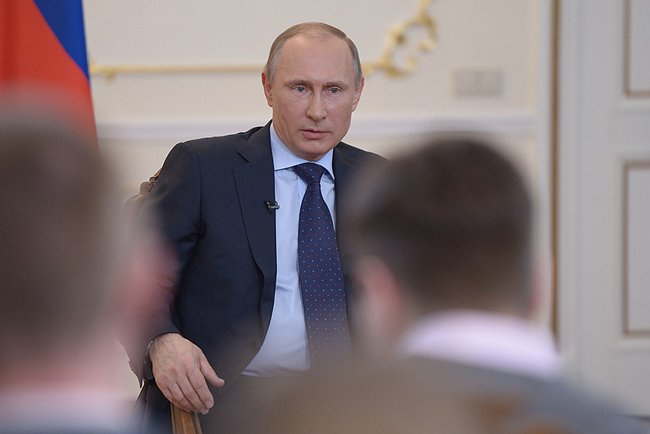
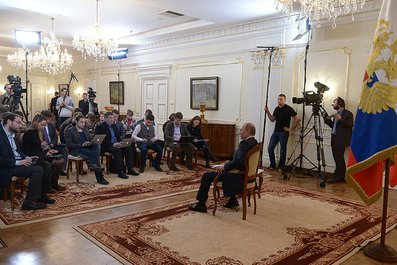 Photo: the
Presidential Press and Information Office| Meeting with media
representatives.|Novo-Ogaryovo, Moscow Region|March 4,
2014|http://eng.news.kremlin.ru/media/events/photos/big/41d4c56e0f549c4eb800.jpeg|http://eng.news.kremlin.ru/media/events/photos/medium/41d4c56e0f5d1316e253.jpeg
Photo: the
Presidential Press and Information Office| Meeting with media
representatives.|Novo-Ogaryovo, Moscow Region|March 4,
2014|http://eng.news.kremlin.ru/media/events/photos/big/41d4c56e0f549c4eb800.jpeg|http://eng.news.kremlin.ru/media/events/photos/medium/41d4c56e0f5d1316e253.jpeg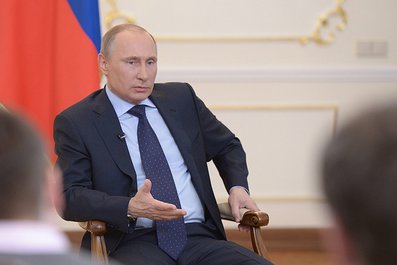 Photo: the
Presidential Press and Information Office| At a meeting with media
representatives.|Novo-Ogaryovo, Moscow Region|March 4,
2014|http://eng.news.kremlin.ru/media/events/photos/big/41d4c56e167c94795c46.jpeg|http://eng.news.kremlin.ru/media/events/photos/medium/41d4c56e16841b936d2c.jpeg
Photo: the
Presidential Press and Information Office| At a meeting with media
representatives.|Novo-Ogaryovo, Moscow Region|March 4,
2014|http://eng.news.kremlin.ru/media/events/photos/big/41d4c56e167c94795c46.jpeg|http://eng.news.kremlin.ru/media/events/photos/medium/41d4c56e16841b936d2c.jpeg Photo: the
Presidential Press and Information Office| At a meeting with media
representatives.|Novo-Ogaryovo, Moscow Region|March 4,
2014|http://eng.news.kremlin.ru/media/events/photos/big/41d4c5710367141f0d22.jpeg|http://eng.news.kremlin.ru/media/events/photos/medium/41d4c571036a7492a2b6.jpeg
Photo: the
Presidential Press and Information Office| At a meeting with media
representatives.|Novo-Ogaryovo, Moscow Region|March 4,
2014|http://eng.news.kremlin.ru/media/events/photos/big/41d4c5710367141f0d22.jpeg|http://eng.news.kremlin.ru/media/events/photos/medium/41d4c571036a7492a2b6.jpeg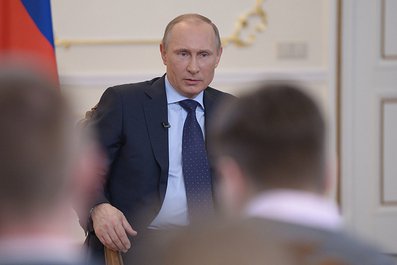 Photo:
the Presidential Press and Information Office| At a meeting with media
representatives.|Novo-Ogaryovo, Moscow Region|March 4,
2014|http://eng.news.kremlin.ru/media/events/photos/big/41d4c5710787cdf2e0d7.jpeg|http://eng.news.kremlin.ru/media/events/photos/medium/41d4c571078f989a8840.jpeg
Photo:
the Presidential Press and Information Office| At a meeting with media
representatives.|Novo-Ogaryovo, Moscow Region|March 4,
2014|http://eng.news.kremlin.ru/media/events/photos/big/41d4c5710787cdf2e0d7.jpeg|http://eng.news.kremlin.ru/media/events/photos/medium/41d4c571078f989a8840.jpeg
The
President of Russia met with media representatives to answer a number of their
questions, in particular with regard to the situation in Ukraine.
PRESIDENT OF RUSSIA VLADIMIR PUTIN: Good
afternoon, colleagues,
How
shall we do this? This is what I’d like to suggest: let’s have a conversation,
rather than an interview. Therefore, I would ask you to begin by stating all
your questions, I will jot them down and try to answer them, and then we will
have a more detailed discussion of the specifics that interest you most.
Let’s
begin.
QUESTION: Mr President, I would like to ask
(you took a lengthy pause, so we have quite a few questions by now) how you
assess the events in Kiev? Do you think that the Government and the Acting
President, who are currently in power in Kiev, are legitimate? Are you ready to
communicate with them, and on what terms? Do you yourself think it possible now
to return to the agreements of February 21, which we all talk about so
often?
QUESTION: Mr President, Russia has promised
financial aid to Crimea and instructions were issued to the Finance Ministry
yesterday. Is there a clear understanding of how much we are giving, where the
money is coming from, on what terms and when? The situation there is very
difficult.
QUESTION: When, on what terms and in what scope
can military force be used in Ukraine? To what extent does this comply with
Russia’s international agreements? Did the military exercises that have just
finished have anything to do with the possible use of force?
QUESTION: We would like to know more about
Crimea. Do you think that the provocations are over or that there remains a
threat to the Russian citizens who are now in Crimea and to the Russian-speaking
population? What are the general dynamics there – is the situation changing for
the better or for the worse? We are hearing different reports from there.
QUESTION: If you do decide to use force, have
you thought through all the possible risks for yourself, for the country and for
the world: economic sanctions, weakened global security, a possible visa ban or
greater isolation for Russia, as western politicians are demanding?
QUESTION: Yesterday the Russian stock market
fell sharply in response to the Federation Council’s vote, and the ruble
exchange rates hit record lows. Did you expect such a reaction? What do you
think are the possible consequences for the economy? Is there a need for any
special measures now, and of what kind? For instance, do you think the Central
Bank’s decision to shift to a floating ruble exchange rate may have been
premature? Do you think it should be revoked?
VLADIMIR PUTIN: Fine, let us stop here for now.
I will begin, and then we will continue. Don’t worry; I will try to answer as
many questions as possible.
First
of all, my assessment of what happened in Kiev and in Ukraine in general. There
can only be one assessment: this was an anti-constitutional takeover, an armed
seizure of power. Does anyone question this? Nobody does. There is a question
here that neither I, nor my colleagues, with whom I have been discussing the
situation in Ukraine a great deal over these past days, as you know – none of us
can answer. The question is why was this done?
I
would like to draw your attention to the fact that President Yanukovych, through
the mediation of the Foreign Ministers of three European countries – Poland,
Germany and France – and in the presence of my representative (this was the
Russian Human Rights Commissioner Vladimir Lukin) signed an agreement with the
opposition on February 21. I would like to stress that under that agreement (I
am not saying this was good or bad, just stating the fact) Mr Yanukovych
actually handed over power. He agreed to all the opposition’s demands: he agreed
to early parliamentary elections, to early presidential elections, and to return
to the 2004 Constitution, as demanded by the opposition. He gave a positive
response to our request, the request of western countries and, first of all, of
the opposition not to use force. He did not issue a single illegal order to
shoot at the poor demonstrators. Moreover, he issued orders to withdraw all
police forces from the capital, and they complied. He went to Kharkov to attend
an event, and as soon as he left, instead of releasing the occupied
administrative buildings, they immediately occupied the President’s residence
and the Government building – all that instead of acting on the agreement.
I ask
myself, what was the purpose of all this? I want to understand why this was
done. He had in fact given up his power already, and as I believe, as I told
him, he had no chance of being re-elected. Everybody agrees on this, everyone I
have been speaking to on the telephone these past few days. What was the purpose
of all those illegal, unconstitutional actions, why did they have to create this
chaos in the country? Armed and masked militants are still roaming the streets
of Kiev. This is a question to which there is no answer. Did they wish to
humiliate someone and show their power? I think these actions are absolutely
foolish. The result is the absolute opposite of what they expected, because
their actions have significantly destabilised the east and southeast of
Ukraine.
Now
over to how this situation came about.
In my
opinion, this revolutionary situation has been brewing for a long time, since
the first days of Ukraine’s independence. The ordinary Ukrainian citizen, the
ordinary guy suffered during the rule of Nicholas II, during the reign of
Kuchma, and Yushchenko, and Yanukovych. Nothing or almost nothing has changed
for the better. Corruption has reached dimensions that are unheard of here in
Russia. Accumulation of wealth and social stratification – problems that are
also acute in this country – are much worse in Ukraine, radically worse. Out
there, they are beyond anything we can imagine. Generally, people wanted change,
but one should not support illegal change.
Only
constitutional means should be used on the post-Soviet space, where political
structures are still very fragile, and economies are still weak. Going beyond
the constitutional field would always be a cardinal mistake in such a
situation. Incidentally, I understand those people on Maidan, though I do not
support this kind of turnover. I understand the people on Maidan who are calling
for radical change rather than some cosmetic remodelling of power. Why are they
demanding this? Because they have grown used to seeing one set of thieves being
replaced by another. Moreover, the people in the regions do not even participate
in forming their own regional governments. There was a period in this country
when the President appointed regional leaders, but then the local legislative
authorities had to approve them, while in Ukraine they are appointed directly.
We have now moved on to elections, while they are nowhere near this. And they
began appointing all sorts of oligarchs and billionaires to govern the eastern
regions of the country. No wonder the people do not accept this, no wonder they
think that as a result of dishonest privatisation (just as many people think
here as well) people have become rich and now they also have been brought to
power.
For
example, Mr Kolomoisky was appointed Governor of Dnepropetrovsk. This is a
unique crook. He even managed to cheat our oligarch Roman Abramovich two or
three years ago. Scammed him, as our intellectuals like to say. They signed
some deal, Abramovich transferred several billion dollars, while this guy never
delivered and pocketed the money. When I asked him [Abramovich]: “Why did you do
it?” he said: “I never thought this was possible.” I do not know, by the way, if
he ever got his money back and if the deal was closed. But this really did
happen a couple of years ago. And now this crook is appointed Governor of
Dnepropetrovsk. No wonder the people are dissatisfied. They were dissatisfied
and will remain so if those who refer to themselves as the legitimate
authorities continue in the same fashion.
Most
importantly, people should have the right to determine their own future, that of
their families and of their region, and to have equal participation in it. I
would like to stress this: wherever a person lives, whatever part of the
country, he or she should have the right to equal participation in determining
the future of the country.
Are
the current authorities legitimate? The Parliament is partially, but all the
others are not. The current Acting President is definitely not legitimate. There
is only one legitimate President, from a legal standpoint. Clearly, he has no
power. However, as I have already said, and will repeat: Yanukovych is the only
undoubtedly legitimate President.
There
are three ways of removing a President under Ukrainian law: one is his death,
the other is when he personally steps down, and the third is impeachment. The
latter is a well-deliberated constitutional norm. It has to involve the
Constitutional Court, the Supreme Court and the Rada. This is a complicated and
lengthy procedure. It was not carried out. Therefore, from a legal perspective
this is an undisputed fact.
Moreover, I think this may be why they disbanded
the Constitutional Court, which runs counter to all legal norms of both Ukraine
and Europe. They not only disbanded the Constitutional Court in an illegitimate
fashion, but they also – just think about it – instructed the Prosecutor
General’s Office to launch criminal proceedings against members of the
Constitutional Court. What is that all about? Is this what they call free
justice? How can you instruct anyone to start criminal proceedings? If a crime,
a criminal offence, has been committed, the law enforcement agencies see this
and react. But instructing them to file criminal charges is nonsense, it’s
monkey business.
Now
about financial aid to Crimea. As you may know, we have decided to organise work
in the Russian regions to aid Crimea, which has turned to us for humanitarian
support. We will provide it, of course. I cannot say how much, when or how – the
Government is working on this, by bringing together the regions bordering on
Crimea, by providing additional support to our regions so they could help the
people in Crimea. We will do it, of course.
Regarding the deployment of troops, the use of
armed forces. So far, there is no need for it, but the possibility remains. I
would like to say here that the military exercises we recently held had nothing
to do with the events in Ukraine. This was pre-planned, but we did not disclose
these plans, naturally, because this was a snap inspection of the forces’ combat
readiness. We planned this a long time ago, the Defence Minister reported to me
and I had the order ready to begin the exercise. As you may know, the exercises
are over; I gave the order for the troops to return to their regular
dislocations yesterday.
What
can serve as a reason to use the Armed Forces? Such a measure would certainly be
the very last resort.
First,
the issue of legitimacy. As you may know, we have a direct appeal from the
incumbent and, as I said, legitimate President of Ukraine, Mr Yanukovych, asking
us to use the Armed Forces to protect the lives, freedom and health of the
citizens of Ukraine.
What
is our biggest concern? We see the rampage of reactionary forces, nationalist
and anti-Semitic forces going on in certain parts of Ukraine, including Kiev. I
am sure you, members of the media, saw how one of the governors was chained and
handcuffed to something and they poured water over him, in the cold of winter.
After that, by the way, he was locked up in a cellar and tortured. What is all
this about? Is this democracy? Is this some manifestation of democracy? He was
actually only recently appointed to this position, in December, I believe. Even
if we accept that they are all corrupt there, he had barely had time to steal
anything.
And do
you know what happened when they seized the Party of Regions building? There
were no party members there at all at the time. Some two-three employees came
out, one was an engineer, and he said to the attackers: “Could you let us go,
and let the women out, please. I’m an engineer, I have nothing to do with
politics.” He was shot right there in front of the crowd. Another employee was
led to a cellar and then they threw Molotov cocktails at him and burned him
alive. Is this also a manifestation of democracy?
When
we see this we understand what worries the citizens of Ukraine, both Russian and
Ukrainian, and the Russian-speaking population in the eastern and southern
regions of Ukraine. It is this uncontrolled crime that worries them. Therefore,
if we see such uncontrolled crime spreading to the eastern regions of the
country, and if the people ask us for help, while we already have the official
request from the legitimate President, we retain the right to use all available
means to protect those people. We believe this would be absolutely legitimate.
This is our last resort.
Moreover, here is what I would like to say: we have
always considered Ukraine not only a neighbour, but also a brotherly
neighbouring republic, and will continue to do so. Our Armed Forces are comrades
in arms, friends, many of whom know each other personally. I am certain, and I
stress, I am certain that the Ukrainian military and the Russian military will
not be facing each other, they will be on the same side in a fight.
Incidentally, the things I am talking about – this
unity – is what is happening in Crimea. You should note that, thank God, not a
single gunshot has been fired there; there are no casualties, except for that
crush on the square about a week ago. What was going on there? People came,
surrounded units of the armed forces and talked to them, convincing them to
follow the demands and the will of the people living in that area. There was not
a single armed conflict, not a single gunshot.
Thus
the tension in Crimea that was linked to the possibility of using our Armed
Forces simply died down and there was no need to use them. The only thing we had
to do, and we did it, was to enhance the defence of our military facilities
because they were constantly receiving threats and we were aware of the armed
nationalists moving in. We did this, it was the right thing to do and very
timely. Therefore, I proceed from the idea that we will not have to do anything
of the kind in eastern Ukraine.
There
is something I would like to stress, however. Obviously, what I am going to say
now is not within my authority and we do not intend to interfere. However, we
firmly believe that all citizens of Ukraine, I repeat, wherever they live,
should be given the same equal right to participate in the life of their country
and in determining its future.
If I
were in the shoes of those who consider themselves the legitimate authorities, I
would not waste time and go through all the necessary procedures, because they
do not have a national mandate to conduct the domestic, foreign and economic
policy of Ukraine, and especially to determine its future.
Now, the stock market. As you may know, the stock
market was jumpy even before the situation in Ukraine deteriorated. This is
primarily linked to the policy of the US Federal Reserve, whose recent decisions
enhanced the attractiveness of investing in the US economy and investors began
moving their funds from the developing markets to the American market. This is a
general trend and it has nothing to do with Ukraine. I believe it was India that
suffered most, as well as the other BRICS states. Russia was hit as well, not
as hard as India, but it was. This is the fundamental reason.
As for
the events in Ukraine, politics always influence the stock market in one way or
another. Money likes quiet, stability and calm. However, I think this is a
tactical, temporary development and a temporary influence.
Your
questions, please.
QUESTION: Mr President, can you tell us if you
expected such a harsh reaction to Russia’s actions from your western partners?
Could you give us any details of your conversations with your western partners?
All we’ve heard was a report from the press service. And what do you think about
the G8 summit in Sochi – will it take place?
VLADIMIR PUTIN: Regarding the expected
reaction, whether the G8 will meet and about the conversations. Our
conversations are confidential, some are even held over secure lines. Therefore,
I am not authorised to disclose what I discussed with my partners. I will,
however, refer to some public statements made by my colleagues from the west;
without giving any names, I will comment on them in a general sense.
What
do we pay attention to? We are often told our actions are illegitimate, but when
I ask, “Do you think everything you do is legitimate?” they say “yes”. Then, I
have to recall the actions of the United States in Afghanistan, Iraq and Libya,
where they either acted without any UN sanctions or completely distorted the
content of such resolutions, as was the case with Libya. There, as you may know,
the resolution only spoke of closing the airspace for government aircraft, while
it all ended with bomb attacks and special forces land operations.
Our
partners, especially in the United Sates, always clearly formulate their own
geopolitical and state interests and follow them with persistence. Then, using
the principle “You’re either with us or against us” they draw the whole world
in. And those who do not join in get ‘beaten’ until they do.
Our
approach is different. We proceed from the conviction that we always act
legitimately. I have personally always been an advocate of acting in compliance
with international law. I would like to stress yet again that if we do make the
decision, if I do decide to use the Armed Forces, this will be a legitimate
decision in full compliance with both general norms of international law, since
we have the appeal of the legitimate President, and with our commitments, which
in this case coincide with our interests to protect the people with whom we have
close historical, cultural and economic ties. Protecting these people is in our
national interests. This is a humanitarian mission. We do not intend to
subjugate anyone or to dictate to anyone. However, we cannot remain indifferent
if we see that they are being persecuted, destroyed and humiliated. However, I
sincerely hope it never gets to that.
QUESTION: How do you asses the reaction of the
west to the events in Ukraine and their threats regarding Russia: are we facing
the possibility of sanctions or withdrawal from the G8?
VLADIMIR PUTIN: Regarding sanctions. It is
primarily those who intend to apply them that need to consider their
consequences. I believe that in the modern world, where everything is
interconnected and interdependent, it is possible to cause damage to another
country, but this will be mutual damage and one should bear this in mind. This
is one thing.
The
second and the most important thing. I have already told you what motivates us.
And what motivates our partners? They supported an unconstitutional armed
take-over, declared these people legitimate and are trying to support them. By
the way, despite all of this we have been patient and even ready to cooperate;
we do not want to disrupt our cooperation. As you may know, a few days ago I
instructed the Government to consider how we can maintain contacts even with
those powers in Kiev that we do not consider legitimate in order to retain our
ties in the economy and industry. We think our actions have been absolutely
reasonable, while any threat against Russia is counterproductive and
harmful.
As for
the G8, I do not know. We will be ready to host the summit with our colleagues.
If they do not want to come – so be it.
QUESTION: Can I add about contacts? The way I
see it, you consider the Prime Minister of Crimea Mr Aksyonov to be a legitimate
representative of government authorities. Are you ready to have any contacts
with those who consider themselves the legitimate authorities in Kiev?
VLADIMIR PUTIN: I have just spoken about it.
You must have missed it.
QUESTION: I mean, at the top level for a
political solution.
VLADIMIR PUTIN: I do not have a partner at the
top level there. There is no president there, and there cannot be one until the
general elections.
As for
Crimea, the Parliament there was formed in 2010, in December 2010 if I remember
correctly. There are 100 MPs representing six political parties. After the
previous Prime Minister resigned, the Crimean Parliament, in compliance with the
existing legislation and procedures elected a new Prime Minister at a session of
the Crimean Supreme Council. He is definitely legitimate. They have complied
with all the procedures envisaged by the law; there is not a single violation.
However, when a few days ago a group of armed men tried to occupy the building
of the Crimean Supreme Soviet, this caused the concern of the local residents.
It seemed as though someone wanted to apply the Kiev scenario in Crimea and to
launch a series of terrorist attacks and cause chaos. Naturally, this causes
grave concern among the local residents. That is why they set up self-defence
committees and took control over all the armed forces.
Incidentally, I was studying the brief yesterday to
see what they took over – it is like a fortified zone. There are several dozen
C-300 units, several dozen air-defence missile systems, 22,000 service members
and a lot more. However, as I said, this is all in the hands of the people of
Crimea and without a single gunshot.
QUESTION: Mr President, a clarification if I
may. The people who were blocking the Ukrainian Army units in Crimea were
wearing uniforms that strongly resembled the Russian Army uniform. Were those
Russian soldiers, Russian military?
VLADIMIR PUTIN: Why don’t you take a look at
the post-Soviet states. There are many uniforms there that are similar. You can
go to a store and buy any kind of uniform.
QUESTION: But were they Russian soldiers or
not?
VLADIMIR PUTIN: Those were local self-defence
units.
QUESTION: How well trained are they? If we
compare them to the self-defence units in Kiev…
VLADIMIR PUTIN: My dear colleague, look how
well trained the people who operated in Kiev were. As we all know they were
trained at special bases in neighbouring states: in Lithuania, Poland and in
Ukraine itself too. They were trained by instructors for extended periods. They
were divided into dozens and hundreds, their actions were coordinated, they had
good communication systems. It was all like clockwork. Did you see them in
action? They looked very professional, like special forces. Why do you think
those in Crimea should be any worse?
QUESTION: In that case, can I specify: did we
take part in training Crimean self-defence forces?
VLADIMIR PUTIN: No, we did not.
QUESTION: How do you see the future of Crimea?
Do you consider the possibility of it joining Russia?
VLADIMIR PUTIN: No, we do not. Generally, I
believe that only residents of a given country who have the freedom of will and
are in complete safety can and should determine their future. If this right was
granted to the Albanians in Kosovo, if this was made possible in many different
parts of the world, then nobody has ruled out the right of nations to
self-determination, which, as far as I know, is fixed by several UN documents.
However, we will in no way provoke any such decision and will not breed such
sentiments.
I
would like to stress that I believe only the people living in a given territory
have the right to determine their own future.
QUESTION: Two questions. You said that sending
troops into Ukraine is an extreme measure, but you are nevertheless not ruling
it out. Still, if Russian troops enter Ukraine, it could start a war. Doesn’t
that bother you?
And a
second question. You say that Yanukovych did not give the order to shoot people.
But somebody shot at the protestors. And clearly, these were snipers, trained
snipers.
VLADIMIR PUTIN: You know, some people,
including those who were recently among the protestors, have expressed the
opinion that these were provocateurs from one of the opposition parties. Have
you heard this?
REPLY: No, I have not heard this.
VLADIMIR PUTIN: Look at these materials – they
are freely available. That is why it is very difficult to get to the bottom of
the situation. But you and I saw for ourselves when the
Berkut fighters stood there with their shields and were shot at – and those were
not air weapons that were used against them but assault weapons that pierced
their shields. That is something we saw for certain. As for who gave the orders
– that I do not know. I only know what Mr Yanukovych told me. And he told me
that he did not give any orders, and moreover, he gave instructions – after
signing a corresponding agreement – to even withdraw all militia units from the
capital.
If you
want, I can tell you even more. He called me on the phone and I told him not to
do it. I said, “You will have anarchy, you will have chaos in the capital. Think
about the people.” But he did it anyway. And as soon as he did it, his office
was seized, and that of the government, and the chaos I had warned him about and
which continues to this day, erupted.
QUESTION: What about the first question? Are
you concerned that a war could break out?
VLADIMIR PUTIN: I am not concerned, because we
do not plan and we will not fight with the Ukrainian people.
QUESTION: But there are Ukrainian troops, there
is the Ukrainian army.
VLADIMIR PUTIN: Listen carefully. I want you to
understand me clearly: if we make that decision, it will only be to protect
Ukrainian citizens. And let’s see those troops try to shoot
their own people, with us behind them – not in the front, but behind. Let them
just try to shoot at women and children! I would like to see those who would
give that order in Ukraine.
QUESTION: Can I ask a question, Mr President?
Our colleagues, my colleagues, who are currently working in Ukraine, are saying
practically every day that the situation for the Berkut fighters is only getting
worse (perhaps with the exception of Crimea). In particular, in Kiev, there are
injured Berkut officers who are in hospitals now, where nobody is treating them
and they are not even getting fed. And their families, including elderly family
members, they simply cannot leave the house, because they are not being allowed;
there are barricades all around, they are being humiliated. Can you comment on
this? And can Russia help these families and colleagues?
VLADIMIR PUTIN: Yes, this issue is of great
concern to us. After all, these are not Russia’s Interior Ministry officers, and
we were not managing the situation there. But out of humanitarian
considerations, it would be good if our human rights organisations got involved
in this as well; we might ask Vladimir Lukin, either alone or together with his
colleagues, representatives from France, Germany and Poland, with whom he
participated in developing the well-known document of February 21, 2014, to go
on location and see what is happening there with these Berkut officers, who have
not broken any laws and acted in accordance with their orders. They are military
service members, they stood there facing bullets, they were doused with fire and
had Molotov cocktails thrown at them. They have been wounded and injured and are
now in a hospital. It is even hard to imagine – even prisoners of war are being
fed and treated. But they not only stopped treating them, they even stopped
feeding them. And they have surrounded the building where these fighters’
families live and are bullying them. I think that human rights organisations
must pay attention to this. And we, for our part, are ready to provide them with
medical care here in Russia.
QUESTION: Mr President, getting back to the
West’s reaction. Following the US Secretary of State’s harsh statement, the
Federation Council suggested that we recall our ambassador to the United States.
Do you support this idea?
VLADIMIR PUTIN: The US Secretary of State is
certainly an important person, but he is not the ultimate authority that
determines the United States’ foreign policy. We hear statements from various
politicians and representatives of various political forces. This would be an
extreme measure. If necessary, it will be used. But I really don’t want to use
it, because I think Russia is not the only one interested in cooperation with
its partners on an international level and in such areas as economy, politics
and foreign security; our partners are just as interested in this cooperation.
It is very easy to destroy these instruments of cooperation and it would be very
difficult to rebuild them.
QUESTION: Russia got involved in Yanukovych’s
fate. How do you see his future role and his future destiny?
VLADIMIR PUTIN: You know, it is very hard for
me to say; I have not analysed it carefully. I think he has no political future,
and I have told him so. As for “getting involved in his fate” – we did this on
purely humanitarian grounds. Death is the easiest way for getting rid of a
legitimate president, and I think that is what would have happened. I think they
would have simply killed him. Incidentally, the question arises: what for?
After
all, look at how it all began, what triggered these events. The formal reason
was that he did not sign the European Union Association Agreement. Today, this
seems like nonsense; it is ridiculous to even talk about. But I want to point
out that he did not refuse to sign the association agreement. He said: “We have
carefully analysed it, and its content does not correspond with our national
interests. We cannot sharply increase energy prices for our people, because our
people are already in a rather difficult position. We cannot do this, and that,
and that. We cannot immediately break our economic ties with Russia, because our
cooperation is very extensive.”
I have already presented these figures: out of
approximately 14 billion [dollars] in export, approximately 5 billion represents
second and third technological processing level products exported to Russia. In other words, just about all engineering products are
exported to Russia; the West is not buying any Ukrainian products. And to take
all this and break it apart, to introduce European technical standards in the
Ukrainian economy, which, thankfully or unfortunately, we are not using at the
moment. We will adopt those standards at some point, but currently, we do not
have those standards in Russia. This means the next day, our relations and
cooperation ties will be broken, enterprises will come to a standstill and
unemployment will increase. And what did Yanukovych say? He said, “I cannot do
this so suddenly, let’s discuss this further.” He did not refuse to sign it, he
asked for a chance to discuss this document some more, and then all this
craziness began.
And why? Did he do something outside the scope of
his authority? He acted absolutely within the scope of his authority; he did not
infringe on anything. It was simply an excuse to support the forces opposing him
in a fight for power. Overall, this is nothing special. But did it really need
to be taken to this level of anarchy, to an
unconstitutional overthrow and armed seizure of power, subsequently plunging the
nation into the chaos where it finds itself today? I think this is unacceptable.
And it is not the first time our Western partners are doing this in Ukraine. I
sometimes get the feeling that somewhere across that huge puddle, in America,
people sit in a lab and conduct experiments, as if with rats, without actually
understanding the consequences of what they are doing. Why did they need to do
this? Who can explain this? There is no explanation at all for it.
The same thing happened during the first Maidan
uprising, when Yanukovych was blocked from power. Why did we need that third
round of elections? In other words, it was turned into a farce – Ukraine’s
political life was turned into a farce. There was no compliance with the
Constitution at all. You see, we are now teaching people
that if one person can violate any law, anyone else can do the same, and that’s
what causes chaos. That is the danger. Instead, we need to teach our society to
follow other traditions: traditions of respecting the main law of the nation,
the Constitution, and all other laws. Of course, we will not always succeed, but
I think acting like this – like a bull in a china shop is counterproductive and
very dangerous.
Please.
QUESTION: Mr President, Turchynov is
illegitimate, from your point of view.
VLADIMIR PUTIN: As President, yes.
QUESTION: But the Rada is partially
legitimate.
VLADIMIR PUTIN: Yes.
QUESTION: Are Yatsenyuk and the Cabinet
legitimate? And if Russia is concerned about the growing strength of radical
elements, they grow stronger every time they find themselves facing a
hypothetical enemy, which in their view, they currently
consider Russia and Russia’s position of being ready to send in troops.
Question: does it make sense and is it possible to hold talks with moderate
forces in the Ukrainian government, with Yatsenyuk, and is he legitimate?
VLADIMIR PUTIN: Listen, it seems like you
didn’t hear what I have said. I already said that three days ago, I gave
instructions to the Government to renew contacts at the government level with
their colleagues in the corresponding ministries and departments in Ukraine, in
order not to disrupt economic ties, to support them in their attempts to
reconstruct the economy. Those were my direct instructions to the Russian
Government. Moreover, Mr Medvedev is in contact with [Arseniy] Yatsenyuk. And I
know that Sergei Naryshkin, as speaker of the Russian parliament, is in contact
with [Oleksandr] Turchynov. But, I repeat, all our trade and economic and other
ties, our humanitarian ties, can be developed in full only after the situation
is normalised and presidential elections are held.
QUESTION: Gazprom has already said that it is
reverting to its old gas prices beginning in April.
VLADIMIR PUTIN: Gazprom could not have said
that; you were not listening carefully or it did not express itself clearly.
Gazprom is not reverting to the old prices. It simply does
not want to extend the current discounts, which it had agreed to apply or not
apply on a quarterly basis. Even before all these events, even before they hit
the crisis point. I know about the negotiations between Gazprom and its
partners. Gazprom and the Government of the Russian Federation agreed that
Gazprom would introduce a discount by reducing gas prices to $268.50 per 1,000
cubic metres. The Government of Russia provides the first tranche of the loan,
which is formally not a loan but a bond purchase – a quasi-loan, $3 billion
dollars in the first stage. And the Ukrainian side undertakes to fully repay its
debt that arose in the second half of last year and to make regular payments for
what they are consuming – for the gas. The debt has not been repaid, regular
payments are not being made in full.
Moreover, if the Ukrainian partners fail to make
the February payment, the debt will grow even bigger. Today it is around
$1.5-1.6 billion. And if they do not fully pay for February, it will be nearly
$2 billion. Naturally, in these circumstances, Gazprom says, “Listen guys, since
you don’t pay us anyway, and we are only seeing an increase in your debt, let’s
lock into the regular price, which is still reduced.” This is a purely
commercial component of Gazprom’s activities, which plans for revenues and
expenditures in its investment plans like any other major company. If they do
not receive the money from their Ukrainian partners on time, then they are
undercutting their own investment programmes; this is a real problem for them.
And incidentally, this does not have to do with the events in Ukraine or any
politics. There was an agreement: “We give you money and reduced gas rates, and
you give us regular payments.” They gave them money and reduced gas rates, but
the payments are not being made. So naturally, Gazprom says, “Guys, that won’t
work.”
QUESTION: Mr President, [German Federal
Chancellor] Merkel’s Press Service said after your telephone conversation that
you had agreed to send an international fact-finding mission to Ukraine and set
up a contact group.
VLADIMIR PUTIN: I said that we have people who
have the training and skills needed to be able to examine this issue and discuss
it with our German colleagues. This is all possible. I gave the instruction
accordingly to our Foreign Minister, who was to or will meet with the German
Foreign Minister, Mr Steinmeier, yesterday or today to discuss this matter.
QUESTION: All eyes are on Crimea at the moment
of course, but we see what is happening in other parts of Ukraine too, in the
east and south. We see what is happening in Kharkov, Donetsk, Lugansk and
Odessa. People are raising the Russian flag over government buildings and
appealing to Russia for aid and support. Will Russia respond to these
events?
VLADIMIR PUTIN: Do you think we have not made
any response? I think we’ve just spent the last hour discussing this response.
In some cases though, the developments taking place are unexpected in my view. I
will not go into the specific details of what I am referring to here, but the
reaction that we are seeing from people is understandable, in principle. Did our
partners in the West and those who call themselves the government in Kiev now
not foresee that events would take this turn? I said to them over and over: Why
are you whipping the country into a frenzy like this? What are you doing? But
they keep on pushing forward. Of course people in the eastern part of the
country realise that they have been left out of the decision-making process.
Essentially, what is needed now is to adopt a new
constitution and put it to a referendum so that all of Ukraine’s citizens can
take part in the process and influence the choice of basic principles that will
form the foundations of their country’s government. But this is not our affair
of course. This is something for the Ukrainian people and the Ukrainian
authorities to decided one way or another. I think that once a legitimate
government is in place and a new president and parliament are elected, which is
what is planned, this will probably go ahead. If I were them, I would return to
the matter of adopting a constitution and, as I said, putting it to a referendum
so that everyone can have their say on it, cast their vote, and then everyone
will have to respect it. If people feel they are left out of this process, they
will never agree with it and will keep on fighting it. Who needs this kind of
thing? But as I said, this is all not our affair.
QUESTION: Will Russia recognise the planned
presidential election that will take place in Ukraine?
VLADIMIR PUTIN: Let’s see how it goes. If it is
accompanied by the same kind of terror that we are seeing now in Kiev, we will
not recognise it.
QUESTION: I want to come back to the West’s
reaction. As all this tough talk continues, we have the Paralympics opening in a
few days’ time in Sochi. Are these Games at risk of ending up on the brink of
disruption, at least as far as international media coverage goes?
VLADIMIR PUTIN: I don’t know, I think it would
be the height of cynicism to put the Paralympics at risk. We all know that this
is an international sports event at which people with disabilities can show
their capabilities, prove to themselves and the entire world that they are not
people with limitations, but on the contrary, people with unlimited
possibilities, and demonstrate their achievements in sport. If there are people
ready to try to disrupt this event, it would show that these are people for whom
there really is nothing sacred.
QUESTION: I want to ask about the hypothetical
possibility of using the military. People in the West have said that if Russia
makes such a decision, it would violate the Budapest Memorandum, under which the
United States and some NATO partners consecrated territorial integrity of
Ukraine in exchange for its promise to give up nuclear weapons. If developments
take this turn, could global players intervene in this local conflict and turn
it into a global conflict? Have you taken these risks into account?
VLADIMIR PUTIN: Before making public
statements, and all the more so before taking practical steps, we give issues
due thought and attention and try to foresee the consequences and reactions that
the various potential players could have.
As
for the Memorandum that you mentioned, you said you are from Reuters, is that
right?
RESPONSE: Yes.
VLADIMIR PUTIN: How do the public and
political circles in your country view these events that have taken place? It is
clear after all that this was an armed seizure of power. That is a clear and
evident fact. And it is clear too that this goes against the Constitution. That
is also a clear fact, is it not?
RESPONSE: I live in Russia.
VLADIMIR PUTIN: Good on you! You should join
the diplomatic service; you’d make a good diplomat. Diplomats’ tongues, as we
know, are there to hide their thoughts. So, we say that what we are seeing is an
anti-constitutional coup, and we get told, no, it isn’t. You have probably heard
plenty of times now that this was not an anti-constitutional coup and not an
armed seizure of power, but a revolution. Have you heard this?
RESPONSE: Yes.
VLADIMIR PUTIN: Yes, but if this is revolution,
what does this mean? In such a case it is hard not to agree with some of our
experts who say that a new state is now emerging in this territory. This is just
like what happened when the Russian Empire collapsed after the 1917 revolution
and a new state emerged. And this would be a new state with which we have signed
no binding agreements.
QUESTION: I want to clarify a point. You said
that if the USA imposes sanctions, this would deal a blow to both economies.
Does this imply that Russia might impose counter-sanctions of its own, and if
so, would they be a symmetrical response?
You
spoke about gas discounts too. But there was also the agreement to buy $15
billion worth of Ukrainian bonds. Ukraine received the first tranche at the end
of last year. Has payment of the remaining money been suspended? If Russia
provides aid, on what specific economic and political terms will this be done?
And what political and economic risks are you taking into consideration in this
case?
VLADIMIR PUTIN: To answer your question, we are
in principle ready to look at taking the steps needed to make the other tranches
available with regard to the purchase of bonds. But our Western partners have
asked us not to do this. They have asked us to work together through the IMF to
encourage the Ukrainian authorities to carry out the reforms needed to bring
about recovery in the Ukrainian economy. We will continue working in this
direction. But given that Naftogaz of Ukraine is not paying Gazprom now, the
Government is considering various options.
QUESTION: Mr President, is the dynamic of
events in Ukraine changing for the better or for the worse?
VLADIMIR PUTIN: Overall, I think it is
gradually starting to level out. We absolutely must send the signal to people in
Ukraine’s southeast that they can feel safe, and know that they will be able to
take part in the general political process of stabilising the country.
QUESTION: You have made several mentions now of
future legitimate elections in Ukraine. Who do you see as compromise candidate?
Of course you will say that this for the Ukrainian people to decide, but I ask
you all the same.
VLADIMIR PUTIN: To be honest, I really don’t
know.
RESPONSE: It seems that the people also don’t
know, because no matter who you talk to, everyone seems to be at a loss.
VLADIMIR PUTIN: I really can’t say. You know,
it’s hard to make predictions after events of this kind. I have already said
that I do not agree with this method of taking power and removing the incumbent
authorities and president, and I strongly oppose this kind of method in Ukraine
and in the post-Soviet area in general. I oppose this because this kind of
method does not inculcate legal culture, respect for the law. If one person can
get away with doing this, it means that everyone is allowed to try, and this
only means chaos. You have to understand that this kind of chaos is the worst
possible thing for countries with a shaky economy and unstable political system.
In this kind of situation you never know what kind of people events will bring
to the fore. Just recall, for example, the role that [Ernst] Roehm’s storm
troopers played during Hitler’s rise to power. Later, these storm troopers were
liquidated, but they played their part in bringing Hitler to power. Events can
take all kinds of unexpected turns.
Let
me say again that in situations when people call for fundamental political
reform and new faces at the top, and with full justification too – and in this I
agree with the Maidan – there is a risk too that you’ll suddenly get some
upstart nationalist or semi-fascist lot sprout up, like the genie suddenly let
out of the bottle – and we see them today, people wearing armbands with
something resembling swastikas, still roaming around Kiev at this moment – or
some anti-Semite or other. This danger is there too.
QUESTION: Just today, incidentally, the
Ukrainian envoy to the UN said that the crimes committed by Bandera’s followers
were falsified by the Soviet Union. With May 9 coming closer, we can see now who
is in power there today. Should we even have any contacts with them at all?
VLADIMIR PUTIN: We need to have contact with
everyone except for obvious criminals, but as I said, in this kind of situation,
there is always the risk that events of this kind will bring people with extreme
views to the fore, and this of course has serious consequences for the
country.
QUESTION: You said that we should make contact
with everyone. Yulia Tymoshenko was planning it seems, to come to Moscow.
VLADIMIR PUTIN: As you know, we always worked
quite productively with all of the different Ukrainian governments, no matter
what their political colour. We worked with Leonid Kuchma, and with [Viktor]
Yushchenko. When I was Prime Minister, I worked with Tymoshenko. I visited her
in Ukraine and she came here to Russia. We had to deal with all kinds of
different situations in our work to manage our countries’ economies. We had our
differences, but we also reached agreements. Overall it was constructive work.
If she wants to come to Russia, let her come. It’s another matter that she is no
longer prime minister now. In what capacity will she come? But I personally have
no intention of stopping her from coming to Russia.
QUESTION: Just a brief question: who do you
think is behind this coup, as you called it, in Ukraine?
VLADIMIR PUTIN: As I said before, I think this
was a well-prepared action. Of course there were combat detachments. They are
still there, and we all saw how efficiently they worked. Their Western
instructors tried hard of course. But this is not the real problem. If the
Ukrainian government had been strong, confident, and had built a stable system,
no nationalists would have been able to carry out those programs and achieve the
results that we see now.
The
real problem is that none of the previous Ukrainian governments gave proper
attention to people’s needs. Here in Russia we have many problems, and many of
them are similar to those in Ukraine, but they are not as serious as in Ukraine.
Average per capita [monthly] income in Russia, for example, is 29,700 rubles,
but in Ukraine, if we convert it into rubles, it is 11,900 rubles, I think –
almost three times lower than in Russia. The average pension in Russia is 10,700
rubles, but in Ukraine it is 5,500 rubles – twice lower than in Russia. Great
Patriotic War veterans in Russia receive almost as much as the average worker
each month. In other words, there is a substantial difference in living
standards. This was what the various governments should have been focusing on
right from the start. Of course they needed to fight crime, nepotism, clans and
so on, especially in the economy. People see what is going on, and this creates
lack of confidence in the authorities.
This
has continued as several generations of modern Ukrainian politicians have come
and gone, and the ultimate result is that people are disappointed and want to
see a new system and new people in power. This was the main source of fuel for
the events that took place. But let me say again: a change of power, judging by
the whole situation, was probably necessary in Ukraine, but it should have taken
place only through legitimate means, in respect for and not in violation of the
current Constitution.
QUESTION: Mr President, if Crimea holds a
referendum and the people there vote to secede from Ukraine, that is, if the
majority of the region’s residents vote for secession, would you support it?
VLADIMIR PUTIN: You can never use the
conditional mood in politics. I will stick to that rule.
QUESTION: Is Yanukovych even still alive? There
have been rumours that he died.
VLADIMIR PUTIN: I have seen him once since he
arrived in Russia. That was just two days ago. He was alive and well and wishes
you the same. He’ll still have a chance of catching a cold at the funeral of
those who are spreading these rumours of his demise.
QUESTION: Mr President, what mistakes do you
think Yanukovych made over these last months as the situation intensified in
Ukraine?
VLADIMIR PUTIN: I would rather not answer this
question, not because I do not have an opinion to express, but because I do not
think it would be proper on my part. You have to understand, after all…
QUESTION: Do you sympathise with him?
VLADIMIR PUTIN: No, I have completely different
feelings. Anyone in this office bears an enormous responsibility on their
shoulders as head of state, and they have rights and also obligations. But the
biggest obligation of all is to carry out the will of the people who have
entrusted you with the country, acting within the law. And so we need to
analyse, did he do everything that the law and the voters’ mandate empowered him
to do? You can analyse this yourselves and draw your own conclusions.
QUESTION: But what feelings do you have for
him? You said “not sympathy, but other feelings”. What feelings exactly?
VLADIMIR PUTIN: Let’s talk later.
QUESTION: You said just two questions back that
we must above all send a clear signal to people in the south and southeast of
Ukraine. The southeast, that’s understandable, but…
VLADIMIR PUTIN: We need to make our position
clear to everyone, really.
We
need to be heard by all of Ukraine’s people. We have no enemies in Ukraine. Let
me say again that Ukraine is a friendly country. Do you know how many people
came from Ukraine to Russia last year? 3.3 million came, and of that number
almost 3 million people came to Russia for work. These people are working here –
around 3 million people. Do you know how much money they send back home to
Ukraine to support their families? Count up the average wage of 3 million
people. This comes to billions of dollars and makes a big contribution to
Ukraine’s GDP. This is no joking matter. We welcome all of them, and among the
people coming here to work are also many from western Ukraine. They are all
equal in our eyes, all brothers to us.
QUESTION: This is just what I wanted to ask
about. We are hearing above all about the southeast of Ukraine at the moment,
which is understandable, but there are ethnic Russians and Russian-speaking
people living in western Ukraine too, and their situation is probably even
worse. They probably cannot raise their heads at all and are a downtrodden
minority there. What can Russia do to help them?
VLADIMIR PUTIN: Our position is that if the
people who call themselves the government now hope to be considered a civilised
government, they must ensure the safety of all of their citizens, no matter in
which part of the country, and we of course will follow this situation
closely.
Thank you.
Assinar:
Postagens (Atom)