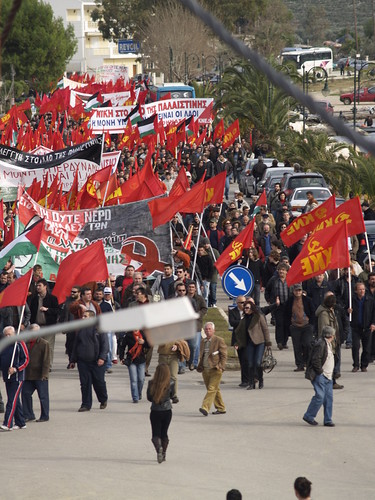
1.The KKE calls on the workers, employees, poor popular strata, pensioners, unemployed and youth, to say a real, unyielding, big NO to the agreement-memorandum, which was signed by the SYRIZA-ANEL coalition government with the EU-ECB-IMF and to fight against the savage measures included in it on the streets and in the workplaces. These measures will be added to the barbaric measures of the previous memoranda. They must organize their counterattack so that the people are not driven to complete bankruptcy. They must strengthen the labour movement, the people’s alliance, so that they can pave the way for the people to be liberated once and for all from the power of capital and the imperialist unions that are leading them to even more barbaric conditions.
Not a day, not an hour must be wasted. Now, with no delay, the people’s activity must be intensified inside the workplaces, factories, hospitals, services, neighbourhoods, through the trade unions, people’ committees and social solidarity and assistance committees. The agreement will lead to a new significant reduction of the people’s income and the crushing of workers’-people’s rights. It legitimizes and gives the green light to dismissals, the expansion of unpaid labour, compulsory leave and other anti-worker measures, which have been taken by the big employers in the recent period, utilizing the restrictions on banking transactions.
The people must not allow the prevalence of complacency, intimidation, fatalism, the fraudulent atmosphere of “national unity” and the false hopes being fostered by the government, the other bourgeois parties, the mass media, various other centres of the establishment, as well as the EU bodies. They are calling on the people to accept the Tsipras memorandum and to feel relieved, because allegedly the worst case scenario has been avoided.
2.The new Tsipras memorandum is comprised of a raft of harsh anti-people measures, which come to intensify the already unbearable burdens of the previous memoranda and application laws that were passed by the ND-PASOK governments. It already bears the stamp of ND, POTAMI and PASOK, because the joint statement they signed and their votes in parliament gave a mandate and carte blanche to the government to form the new barbaric measures that accompany the agreement. The stance of a large section of the privately owned mass media is also revealing, which had accused SYRIZA of allegedly wanting to take Greece out of the Eurozone via the referendum, but now is applauding its choices, praising it, because it “returned” to realism.
Today, the parties of the NO (SYRIZA-ANEL) with the parties of the YES (ND-POTAMI-PASOK) are calling on the people to say YES to a new memorandum, which thrusts new burdens onto the working class and poor popular strata and indeed with anti-people measures, like those that had been rejected by the large section of the Greek people in the referendum.
The government is essence is burdening the people with a new loan worth 86 billion euros and savage measures that accompany it, such as the further reduction of the people’s income, the new heavy taxes, the maintenance of ENFIA (the new property tax), the significant increase of VAT on items of mass popular consumption and the solidarity levy, the reduction of pensions, the implementation of a new and worse social-security regime, the gradual abolition of EKAS (supplementary pensions for poor pensioners), privatizations, measures from the OECD’s “toolkit” etc.
The same blackmail and dilemmas are being used against the people that have been deployed repeatedly for 5 years now in order to make them accept these measures: a new even harsher memorandum or state bankruptcy, via a grexit? The same dilemma that was posed for memorandum 1 and 2 and on every occasion before an installment was to be disbursed has been repeated. Every time the people must choose the “lesser” evil, which in the end leads to the greater evil. The SYRIZA-ANEL coalition government today is using the same tactics and rhetoric.
3.The government provided valuable services to the system, as it from the very first moment “dressed” its compromise with leftwing slogans and the mask of dignity. It directed false dilemmas against the people, in a period when opposition to the EU should have acquired a radical content and led to the rejection of the capitalist development path itself which goes hand in hand with the our country’s participation in inter-state imperialist alliances, which are always formed on the basis of the unequal relations between states. It organized a referendum with a false question and then later transformed the “no” into a “yes” for an even more barbaric memorandum.
SYRIZA consciously exploited the people’s desire for the consequences of the 2 memoranda to be abolished, which would mean at least a recovery of the losses of the popular strata. It exploited the vision and dreams of leftwing people and radicals who longed for a “leftwing”, “pro-people” government. It utilized the inevitable political devaluation of ND and PASOK so that it could become the government. Today, through the new memorandum, it is providing an “absolution of the sins” for the memoranda of ND-PASOK.
It used popular demagoguery, as well as its public commitment to big capital that it will support the recovery of its profitability and that it will be able to restrict the regrouping and recovery of the labour-people’s movement. It won the toleration and even support of the basic core of the bourgeois class in Greece, as well as of foreign imperialist centres, like the USA. The alliances with the USA, France, Italy, which the government is proud of, are in no way a “shield” for the people’s interests. In reality, these are “dead weights” that drag the working class and the popular strata into the dangerous and sharpening confrontations amongst the imperialists.
The KKE from the beginning argued and demonstrated that SYRIZA did not want and was not able to prepare the people for the confrontation against the memoranda and the monopolies, both Greek and European, precisely because it has no orientation for resistance and conflict. On the contrary, it did what it could to keep the people passive, so that they would sit and wait to cast their “protest vote” in the elections. It deceived the people that it could pave the way for pro-people changes, inside the predatory alliance of the EU.
The Left Platform of SYRIZA and all those who are trying to hide their enormous responsibilities behind their “abstention” or “present” in parliament played a particular role in the manipulation of the movement, in the entrapment of radical people. These forces are trying to save themselves politically and play a new role in the containment of radicalism and in the assimilation of the people into the system, preparing a new political “shock absorber”, the role that was played by the old “Synaspismos” party in the past.
4. Especially today, certain conclusions that are valuable for the people must not be forgotten:
The “tough” negotiation was from the beginning a minefield for the people’s interests, as it served the aim of capital for the recovery of its profitability. Greece’s participation in the EU and the Eurozone remains the strategic choice of the Greek capital and it is characterized by unequal conditions, which objectively exist in such imperialist alliances. In the framework of these alliances, the Greek state is obliged to compromise with the stronger centres, like Germany, thrusting the consequences of these unequal relations onto the workers.
These developments constitute the clearest expression of the failure of the so-called “renewed” or “governmental left”, of the theory that the EU can change its monopolistic and anti-people character. They highlighted the collapse of the so-called “anti-memorandum” line that promoted the bourgeois social-democratic aim of the reconstruction of production, without radical changes at the level of the economy and power.
The line of struggle of the KKE and its robust and consistent stance, which rejected participation in such “leftwing governments” that are really governments of bourgeois management, have been borne out.
As a whole, the processes for the recomposition of the bourgeois political system are accelerating after the recent developments. Either through a reshuffle and possible broadening of the government’s base or through elections and the creation of new parties and “shock absorbers”. In any case, the offensive against the KKE is the consistent choice of the system, so that the people’s indignation does not join with the anticapitalist antimonopoly line of struggle. A new anti-people alliance of the “willing” is being raised against the people in order to impede any spirit of resistance and emancipation. Today, the intensification of state and employer repression is rearing its head threateningly, as well as the increase of authoritarianism, in order to prevent the organization of the labour movement and its allies and the development of the class struggle.
5. The fact that the departure of a country from the Eurozone for the first time was posed so intensely and directly is due to the sharpening of the internal contradictions and unevenness of the economies of the Eurozone, to the competition between older and new imperialist centres, which emerged after the counterrevolutions in the countries of socialism. These problems sharpened in the conditions of the prolonged economic crisis in Greece and elsewhere. Splitting trends have been strengthened, which are supported by bourgeois political forces that want a Eurozone of the countries with stronger economies. There is a strong trend in Germany, which is fomented by leading forces in the IMF, for their own reasons and interests, and this leads to the sharpening of the contradictions inside the Eurozone. Inter-imperialist contradictions have been expressed inside the Eurozone, chiefly between Germany and France, and also contradictions amongst the USA and Germany and other imperialist centres as regards the issue of Greece remaining in the Eurozone. The USA intervened, wishing to restrict Germany’s hegemony in Europe, without for the present desiring the dissolution of the Eurozone.
The contradictions and developments in the Eurozone, in the EU as a whole, have not been checked by today’s temporary compromise and the ratification of the agreement between Greece and the Eurozone-IMF. The trend remains strong, leaving the possibility of a grexit open, for the restructuring of the Eurozone, with the deepening of the mechanisms for a unified economic policy, and also with stricter rules and monitoring mechanisms regarding the positive balance between state spending and income. In any case, it is no accident that France and Italy, which resisted the choice of Greece’s exit from the Eurozone, are countries with high deficits and debts and seek a relaxation of the strict rules.
The confrontation over the issue of the debt is a result of these contradictions. The government, in line with the IMF and the USA, elevated the adjustment of the debt as the ultimate goal for the people, at all costs and at the expense of the people’s interests. At the same time, it is asking for a new loan of 86 billion euros which will increase the debt. It wants the people to accept the anti-people measures in the name of a new management of the debt, which whenever it happened in the past was accompanied by attacks on the worker’s –people’s rights. Capital will be the only beneficiary from the financing in the form of a new loan-debt or via its extension.
6. For a real solution in favour of the people there needs to be a real rupture, which has no relation to the caricature of a rupture being invoked by forces inside and outside SYRIZA that promote the capitalist Greece of the Drachma as the way out. The option to exit the euro and adopt a national currency, inside the capitalist development path, is an anti-people one supported by important sections of the bourgeois class in Germany, on the basis of the “Schauble plan”, as well as in other member-states of the Eurozone, and indeed by other reactionary forces. Today, sections of capital in our country are flirting with this choice, hoping for immediately greater profits.
Those that claim that Greece’s exit from the Eurozone, with a depreciated currency, will lend impetus to competitiveness and growth with positive consequences for the people are engaged in conscious deception. Whatever capitalist growth is achieved in the future will not be accompanied by the recovery of the salaries, pensions, rights and for this reason it will not benefit the people. It will lead to new sacrifices of the people on the altar of the competitiveness of the monopolies.
Capitalist Greece with a national currency does not constitute a rupture in favour of the people. The political forces that promote such a goal as a solution or as an intermediate goal for radical changes (Left Platform of SYRIZA ANTARSYA etc) are objectively playing the game of sections of capital.
This choice will not lead to the relatively better standards of living of the 1980s and 1990s, as certain people claim. The laws of capitalist exploitation, the unrelenting monopoly competition will “reign”. The EU and NATO commitments will tighten the “vice”. The barbaric laws of lending hold true in all the money markets, investment banks and the funds of the current or other imperialist alliances (like BRICS). In any case the anti-people policies are being implemented in countries in the euro and also in capitalist countries with national currencies, in stronger countries like China, Britain, Russia and in weaker ones, like Bulgaria and Romania.
The slogans about alleged dignity for the “poor but proud Greece which resists the strong” are aimed at concealing the truth from the people and subjugating them to barbarity. The people can not feel proud, when the wealth they produce is stolen from them and they become bankrupt in order to save the capitalist system from the crisis, inside or outside the euro.
It is one thing for the people themselves to choose to leave the EU, consciously and actively, taking the keys of the economy and power into their hands at the same time and another completely different thing for a country to find itself outside the Eurozone, as a result of the contradictions and competition of the capitalists. The former constitutes an alternative solution in favour of the people and is worth every sacrifice, the latter leads to the people’s bankruptcy by another path.
7. The political proposal of the KKE-social ownership, disengagement from the EU and NATO, unilateral cancellation of the debt, with workers’-people’s power-is directed to the salaried workers and popular strata, the youth and women from the families of the working class and popular strata, the pensioners, because these forces were and are the real motor forces of society. Social prosperity can be ensured on the basis of their work, without unemployment, hunger, destitution, without exploitation. What is needed is for them to become the protagonists of the social and political developments, to act for their own interests, for their own lives, with the KKE against the power of their exploiters.
Nothing was ever granted by the exploiters and their state. Workers’-people’s power will not be granted by the bourgeois political system or by any “leftwing” party, it must be conquered. The course for a real change in the correlation of forces in favour of the workers’-people’s majority requires that the people rally around the KKE and that the KKE is strengthened everywhere, above all in the workplaces and people’s neighbourhoods.
The comprehensive strengthening of the KKE and joining forces with it are prerequisites for the regroupment of the labour movement and the formation of a strong people’s alliance, which will conduct struggles regarding all the people’s problems, demand immediate relief measures, the recovery of losses, with a stable orientation of fighting against the monopolies and capitalism.
Its formation and strengthening can from today assist the change of the negative correlation of forces, the reinforcement of the organization, combativeness, militant spirit of the working class and the other popular strata against fatalism and the submission of the people, against the old and new managers of the capitalist barbarity.
The CC of the KKE
13 of July 2015